Train Journey 12- Hazardous journey to Nepal

Train Journey 12 – Train to Nepal
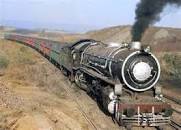
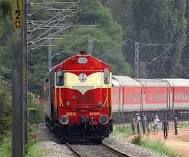
2003 March – Telecom Employees Association of Nepal (TEAN) has invited me as GS of BSNLEU to attend their TU class at Bharatpur on 12th March 2003. Since this is near India- Nepal border along UP – Bihar, I thought better to go by train. Started from Delhi on 10th by Saptagiri Express to Gorakhpur. Since I could not even enter the reserved 3-Tier compartment due to heavy rush by reserved and un-reserved passengers, I got in to II AC compartment and gave the extra amount to TTE. Such things happen. Reached Gorakhpur in the morning, where Com.K.D.M.Tripathi, Vice-President of Union was waiting. He was a sincere dedicated leader. He belonged to the priest family of famous Gorakhpur temple.
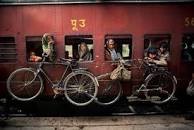
At 11.30 hours we started. On the way the train stopped in a small station due to some technical fault. We proceeded from there on a local train. It was fortunate that by the clever maneuvering of Tripathi, we got two side seats in an ordinary compartment. On both sides of the train, there were dozens and dozens of bi-cycles cleverly hung on the window bars, similar to milk cans hung on the Mumbai trains. Tripathi told me that passengers get down, unload the cycles and continue their journey to their villages. Very interesting. The train did not start for a long time and more and more passengers were getting in. Six – seven women boarded carrying big pieces of old wooden railway sleepers which were in the platform. In fact, they were stealing them. They put it under the seats. Many old jute bags were also with them. They were watching the station carefully. We had put our bags on the upper stand. Tripati told me, ‘always watch our bags, may disappear any time.’ I understood.
At last train started. It was stopping at all stations. After two – three stations, the women got down carrying the wooden sleepers. All of sudden, there was shouting by a young man clutching one of the bags taken away by them. It was his bag. The women told it is their bag. Others intervened, opened the bag and found out it was the boy’s bag only.
I wanted to have coffee or tea and Tripathi told that he will go outside in the next station and will bring tea, because if both of us go, our bags may ‘disappear’. He tried at two three stations, but no tea or coffee. Somehow he got two packets of roasted ground nuts, which we ate and drank water which we carried. We reached a station, may be 10 miles from the border by late evening. Went to a tea shop nearby, but came out quickly since the shop was most dirty and unhygienic.
We got in to a bus going to the border town Raxaul. We got seats. Though the bus seemed very old and worn, there was T.V. fitted and on. We were happy to watch the TV. Before start of the bus some persons boarded and stood very close to the TV blocking the view to all others behind. Nobody objected. When I wanted to protest, Tripathi signalled me,’danger’. I understood. The bus started. The road was so bad, that the bus was turning and tumbling this side and that side. We were afraid that it may fall or crash down. The speed was almost like that of a bullock cart moving on a rough patched road. Though the distance was about ten miles, it took about one and half hours to reach there.
We got down, engaged a tonga and crossed to Nepal. The Raxaul town was partly in India and partly in Nepal. TEAN leaders Com. Ashok Karn and others were waiting there. They took us to a hotel telling that we will move to Bharatpur next day to attend the TU meeting and class. We were so tired that we slept heavily.
Had Com.Tripathy was not there with me ?

P and T TU Movement in India during II World War and thereafter (1939 – 1954) ( by B.N.Ghosh ) CHAPTER : XVI FORMATION OF UPTW (contd..)

CHAPTER : XVI FORMATION OF UPTW (contd..)

The Jubilee session of the All India Trade Union Congress which was held in Calcutta from the 13th to 19th Feb, 1947 under the president-ship of Shri. Mrinal kanti Bose, granted affiliation to the All India Postal and RMS Union and the All India Postmen and Lower Grade Staff Union. The congress session was attended by 27 delegates from both these unions. The following were elected as members of the All India trade Union Council:
1. Com. V.g.Dalvi
2. “ S.P.Anand
3. “ K.S.Dharia
4. “ Mrinal Kanti Bose
5. “ Om Prakash Gupta
6. “ B.N.Ghosh
7. “ Raj Bahadur
8. “ M.Alim
9. “ K.S.Pitkar
The communication formed an independent group in the Trade Union Congress. Shri. Mrinal kanti Bose and Shri. V.G.Dalvi were elected as member of the working Committee.
The session was a largely attended. I had the privilege of addressing the open session on the 13th. I remember to have spoken on strike period pay and on the grievances of the E.D.Staff. Shortly after the session was over the General Council met at the Moti Seal Free School under the Chairman-ship of Shri.M.N.Joshi, the newly elected President. In the Council, I drew special attention of Sri.Joshi to need for publishing the cost of living index of all big cities to which he agreed.
After the session of the Trade Union Congress was over, it struck me that if other recognised P&T Unions would also join the Trade Union Congress, it would pave the way for establishing one union of the P&T workers. My attempt to that direction did not bring any result. By joining the All India Trade Union Congress the prestige and position of the All India Postal and RMS Union had greatly increased. Some of the Unions had made forecast that the Government would object to the P&T Unions joining the Trade Union Congress but in fact no such opposition came from the Government side. By joining the Trade Union Congress both the unions established the rights and claims that the P&T Unions are not service associations but trade unions.
If an analysis is made as to what is a trade union, it will come out that in the trade union congress’ constitution it was nicely explained in the following words:-
“What is trade union?:-
A trade union is an organ of class struggle; its basic task, therefore, is to organize the workers for advancing and defending their rights and interests, and although collective bargaining is the necessary implication of a trade union and although in the transactional period to socialism, negotiations, representations and other methods of collective bargaining must remain as an integral part of trade union activities, labour and capital cannot be reconciled within the capitalistic system”.
The All India Postal and RMS Union, Bengal and Assam Provincial union got itself affiliated to the Bengal Provincial Trade Union Congress. I was given an opportunity to serve as a member of the working committee of the B.P.T.U.C and Sarbasree K.D.Roy Choudhry, J.N.Banerjee and myself were members of the General Council of the Provincial Trade Union Congress.
Coming in contact with the Trade Union Congress leaders, we took decision to run our union on trade union lines. During the days of the unions were within the Trade Union Congress, their activities greatly increased.
On the other side, a section of the leaders of the All India Postal and RMS Union headed by Com. Om Prakash Gupta the General Secretary of the Union, began in right earnest for preparing the grounds for establishing one union of P&T workers. Com .Gupta with his youthful energy wrote series of articles in the Indian Post advocating in favour one Union.
In March, 1947 issue of Indian Post, the Journal of the All India Postal and RMS Union, under the joint signatures of Coms.V.G.Dalvi, Mrinal Kanti Bose and Om Prakash Gupta was published a detailed scheme for amalgamation of all the P&T Unions. This scheme gave food for thought to all.
Since adoption of merger resolution at the Akola Conference of the All India Postal & R.M.S Union, The Indian Posts and Telegraphs Union came forward to ridicule the idea in the editorial of the POSTAL ADVOCATE, the journal of the Union in January, 1947 issue wrote justifying existence of so many unions.
It dittoed the policy of certain anti-trade unionists of great Britain of 1920 model who opposed the “closed shop policy “(one union) by saying that several organizations tend rather to strengthen than to weaken the cause of workers. It further contended in writing “Let there be healthy rivalry and competition in different unions catering for the same class of employees. The weaker and the inefficient of them will stand out and serve the cause of their members better.” It further went to the length of suggesting that as the existing Federation was there a parallel Federation to be established.
The “Telegraph Review” the journal of the All India Telegraph Union in its editorial of January, 1947 issue rejected the idea of one union and strongly advocated formation of one union only for the Telegraph, Telephone and Engineering Employees.
The Central Committee of the All India Telegraph Union also supported the idea of one union of Telegraph, Telephone and Engineering employees.
In spite of above facts the mass of the P&T workers who had been growing more conscious on the need of one union in one industry began putting pressure on the leadership. Even in the Postal and R.M.S Union and the Postmen & Lower Grade Staff Union a strong section was against having one union. Future events will show that the general Workers were in a position to influence the leadership of the Indian Posts and Telegraphs Union and the Indian Telegraph association to take a different view in the matter.
On the 30th of April, 1947, the Central Pay and Commission submitted its report to the Government. It’s Recommendations were most disappointing. None of the unions was satisfied with the findings of the Commission. The dissatisfaction amongst the mass of the P&T workers was this time at its height. All the Unions leadership began thinking as to how through concerted action the wrong done by the Pay Commission to the P&T workers could be righted. Every cloud has its live linking. The unsatisfactory Recommendation of the Pay Commission later on brought changes in the way thinking in the leadership of the Indian Posts and Telegraphs Union and the Indian Telegraph Association.
The Executive Council of the All India Postal & R.M.S Union which met at Delhi from the 12th to the 15th of June not only declared the recommendation to be unsatisfactory but took a decision to advance the cause for establishment of one union and adopted the following resolution:-
“This Council appeals to the Provincial, Divisional and District Branches and individual members to carry on an extensive propaganda amongst all members and members of the sister unions to arouse consciousness in favour of a single union and to achieve the same. They are directed to submit ordinarily a monthly report to the All India office on the efforts made”.
A convention of the District Secretaries was also held on the 15th June at the Union Academy, Raja Bazar, New Delhi. It was a largely attended gathering. I had the proud privilege of presiding over the convention which also took unanimous decision in favour of effecting merger of all the existing P&T Unions and expressed utmost dissatisfaction at the unsatisfactory recommendations of the Pay Commission.
Dr.G.Noronha General Secretary of the Indian Telegraph Association, who attended the Convention expressed definite opinion that in view of the injustice done to the P&T workers by the Pay Commission, establishment of the union was essential. Such a union if established the opinion would have enough potentiality, and would be in a position to achieve the objectives through struggle. He declared that his Association would like to join the proposed one union. On the 17th of June, Dr.Noronh, Shri.J.N.Banerjee, Shri.Om Prakash Gupta, myself and a few others met at Devico Restaurant in the Regal Buildings and had preliminary discussion as to how to advance the cause of the union movement. Dr. Noronha agreed to call a meeting of the different unions representatives in Calcutta on the 2nd July 1947.
On the 3rd June, Shri.P.C.Chatterjee General Secretary, All India Telegraph Union wrote to Com.Om Prakash Gupta that the A.I.T.U would join merger provided equality of voting between Postal and Telegraph side finds a place in the constitution .
On the 21st June, the Working Committee of the Indian Posts and Telegraph Union, Madras Provincial Branch, adopted the following resolution:
“This Working Committee directs Mr.Jabber and Shri.Sreepada Rao to inform the General Secretary of the I.P.T.U at Delhi that irrespective of the fact whether the Federation participates or not in the merger talks proposed to be held in Calcutta on the 2nd July 1947, this Working Committee is strongly of opinion that the I.P.T.U, must participates in such talks and make every effort to achieve the ideal of merger of all unions or devise any other machinery for creating unity and taking joint and concerted action”.
The General Secretary of the I.P.T.U agreed to the proposal. The news of participation of I.P.T.U in the merger talks in Calcutta created enthusiasm amongst the member of the Postal and R.M.S Union everywhere.
In these days rapid changes were taking place. By the time everybody had known that the British would leave India and that the country would achieve independence on the 15th August, 1947. The partition of the country in the East and West was known to be fait accompli. The Hindu P&T workers in West Punjab Sind and N.W.F.P and East Bengal were preparing for opting for India whereas the Muslims of India were preparing for would be Pakistan. Thus it was a transitory period. The Interim Government was manned by national leaders. Every soul was eagerly awaiting for the day which would bring freedom from bondage of 200 years. The thoughts and ideas were cropping up in every mind. A large section of the P&T Workers too did not lag behind. I am bribed with the spirit of unity they came forward to translate it into action. Com.Om Prakash Gupta who was already authorized to prepare the ground for amalgamation of the unions visited Madras and Bombay. In both the places he got encouraging support. Com.Gupta met Shri. V.G.Dalvi and Shri. K.S.Dharua on 24-4-47 at Bombay and discussed the entire matter relating to merger of unions. Shri.Dalvi agreed to work for the scheme to which he had already put his signature. Some hold the view that the following were the reasons which hastened effecting of merger of unions:
1. Unsatisfactory recommendations of a central Pay Commission.
2. Partition of the country.
3. Impending independence of the country.
4. Growing consciousness and urge for unity amongst the rank and file of workers.
On the 2nd July 1947 the representatives of four unions met at Olympia House, Calcutta, under the president-ship of Shri.Dalvi, duly authorized by their representative unions. The following gentlemen took part in the meeting:
Com. Om Prakash Gupta }
“ B.N.Ghosh }
“ K.S.Pitkar } All India Postal and R.M.S.Union
“ K.D.Roy Choudhry }
“ Raj Bahadur )
Com. B.S.Kamble }
“ Mrinal Kanti Bose } All India Postal and RMS union
“ M.A.Jabar }…………………………………………………..
“ K.V.Sreepada Rao } Indian Postal and Telegraph Union
“ P.Madhava menon }…………………………………………………………..
Dr. G.Noronha }
Com. B.G.Das } Indian Telegraph association
“ J.Subramaniam }
“ L.J.Gomes }…………………………………………………….
“ V G Dalvi Postmen Union.
The last session of the Merger Committee met at the Tarapada Hall on the 5th July. The Committee finalized the draft constitution for the Union of the Post and Telegraph Workers and the members of the merger Committee put their signatures and decided to hold the All India Conference of the respective Unions as well as the Merger Conference on and from the 12th August, 1947 at Delhi. It is worth mentioning that Shri.P.C.Chatterjee , General Secretary of the All India Telegraph Union who promised to join the meeting provided parity clause was embodied in the constitution, did not turn up to join the meetings of the Merger Committee assurances given to him by all that such a clause would be incorporated.
The decision of the Merger Committee was released under the joint signatures of Messrs. V.G.Dalvi, C.Noronha, M.A.jabbar and Om Prakash Gupta. The decision was as follows:
1. “The main decision taken by the representatives of the Merging Unions was the decision to accept the Constitution enclosed in toto, and to request their members to accept this Constitution as it stood, without amendments, since the introduction of amendments by the members of any one Union would involve further consultation with the other Unions and would be likely to throw the entire Constitution back into the meeting pot. The merging Committee, therefore, considered it essential that the members of each Union should accept the Constitution as a whole, and defer any amendments which they wish to introduce to a later date after the new Union had been fully established.

2. The second major decision was that each of the four Unions which had participated in the conference should make a contribution of Rs. 2500/- each to start the new Union with a small capital fund, and that each Union should be left completely free to dispose of its other assets, if any, and its members desire, subject to start another Union.
3. Thirdly, the Merging Committee agreed that the new Union should, as far as possible, take over the staff of the pre-existing Unions.
4. Fourthly, and finally, the Merging Committee agreed that their respective institutions should hold, as far as possible their extra-ordinary meeting or Conferences for the purpose of effecting amalgamation, in Delhi on the 12th August.
The Conference of the Indian Posts and Telegraphs Union, Indian Telegraph Association, All India Postal and R.M.S Union and All India Postmen and Lower Grade Staff Union met at Delhi on the 12th August in all enthusiasm. All the first three unions in their respective Conference passed resolutions in favour of merger. The Postmen Union Conference, however, rejected the proposal.
On the 13th of August ,1947, two days before the country achieved Independence, the Merger Conference of the Three Unions met under the president-ship of Shri.B.S.Kamble. Amidst acclamation it adopted unanimously a resolution establishing the Union of Posts and Telegraph Workers. Thus the dream of one union became a partial reality. The Postmen Union and the All India Telegraph Union kept out of the unity move. The three great unions which up to 12th of August were functioning as separate organizations, with the establishment of the Union of Posts and Telegraphs Workers in a moment’s time forgot their past separate entities. The entire members of those unions numbering about fifty thousand souls felt as if they were members of the same family.
The Merger Conference elected the following gentlemen as office bearers of the Union of Post and Telegraph Workers
Com.N.M.Joshi – President
Dr.G.Noronha – Vice-President
Com.M.A.Jabbar }- Joint General Secretaries.
Com.Om Prakash Gupta }
The Conference also set up two bodies, one known as the Co-ordinating Committee and the other as the Negotiating Committee and framed and passed a Charter of Demands divided in to two parts such as the Short-term and the Long-Term Demands. The Co-ordinating Committee very ably effected merger of the three unions at the Circle, Divisional and Branch levels. The Negotiating Committee began negotiations on the demands embodied in the Charter. (to be continued)

AUAB on Struggle Path – Organised Black Badge wearing and Demonstration on 16th July 2020

BSNL Employees as per the call of the All Unions and Associations of BSNL (AUAB) organised Black Badge wearing and Demonstration on the following demands on 16-07-2020

(i) BSNL should immediately be allowed to roll out its 4G Services.

a) BSNL should take immediate actions to upgrade the 4G compatible BTSs.

b) Add on order for 4G equipments as per Phase VIII.4 tender should be issued immediately.

c) In the matter of procuring new equipments and upgradation, there should not be any discrimination, between BSNL and other private telecom service providers.

(ii)The Government should immediately implement the decisions contained in BSNL Revival Package.

(iii) Urgent measures should be undertaken by the BSNL Management for immediately improving the quality of service.

(iv) The Management should ensure that the salary payment of the employees is made on the last working of every month. Deductions made from employees salary, on account of society dues, should immediately be remitted.

(v) The Management should immediately take steps to ensure that the employees get cashless treatment from empanelled hospitals during Covid-19 pandemic. The Management should pay Rs.10 lakh to the family of the employees who die due to COVID-19, based on the instructions issued by the DoT in such cases.

(vi) Make payment of the wage arrears of the contract workers, which is remaining pending for more than 1 year, without any further delay.

(vii) Immediately clear the payment of pending electricity bills, rental, vehicle, temporary advance, housekeeping etc.

Congratulations to the AUAB and BSNL workers!

Sad news – Com. Sarbajit Singh, DS BSNLEU Amritsar no more

Very sad news have been received that Com. Com.Sarbajit Singh, District Secretary, BSNLEU, Amritsar has passed away at 06.00 P.M. on 15th July 2020. He was not well for the past few days. He was only 58 years. He was very active in union activities and built up a strong union in the district.

I remember the early days when along with senior Punjab comrades visiting Amritsar on organisational tour. We did not have a strong union there at that time. But due to the continued efforts of Com.Sarbajit and his comrades, within a few years we could built up a strong base. He was also active in general trade union movement.

His premature death is a great loss.

My  heartfelt condolences to the bereaved family, comrades and friends.

Train Journey 11 – Wrong Train, Right Train

Not remembering date and year. After Circle Conference at Khammam had to Return to Delhi by G.T.Express reaching Khammam from Chennai at about 00.30 hours in midnight. Reservation already made. Along with Com.J.Sampath Rao, P.Asoka Babu etc. reached the Railway Station in the nick of time. Train was already in the station and was starting to move. My three bags with warm clothes, union records etc.were just thrown inside my reserved compartment by our comrades, I got in and train started. I went to my berth and sat with relief.

All of a sudden, I felt something was wrong. The compartment was almost empty. GT used to be always full. One boy was sitting in the side seat. On asking I found out to my dismay it was a train to Hyderabad or so. I had to attend urgent meetings on 10th and 11th at Delhi including with Secretary, DOT. I had somehow to catch GT to reach Delhi in time. I pulled the chain but it was not moving. It was in a fixed condition. Even other wise, there was no meaning since the train has already passed much beyond the station. I realised that GT Express is yet to come. In our haste to get in we did not notice which was the train. In the hope that I will change the train at the next station after getting down and catching the coming GT, I referred the Railway Time Table, which I always carried with me. But GT will reach that station, before this train reaches there. That means, this train will stop somewhere and allow the GT to pass.

The train stopped after some time in a very small station. In the platform, there was no light. I got down with my luggage. Knee high grass was all over. I walked back to the Guard’s compartment and spoke to him. I requested him to get the GT Express stopped there so that I can get in. He ridiculed me stating that how can GT stop there, where there is no stop. He told me to get inside the train, get another train next day for Delhi. He also warned me that this is naxal area and you have to be very careful. When I insisted, he told me to go to the first platform where the Assistant Station Master will be there and seek his help. I crossed all the three tracks of railway lines got up to the platform on the other side with much difficulty. The Station Master was in his small room. No other building. It was a very small station, probably with only one or two trains in the whole day.

First he was taken by surprise seeing me like that. Then I explained and pressurised him to somehow stop the coming GT express to enable me to catch and reach Delhi in time. He was sympathetic. He contacted the control room and conveyed my request. He was shouted at by the Control room for putting such a request. The ASM, then called the Guard. Guard contacted Khammam, but GT has already left. By the time, we could see the train coming. All of us got down near the central track. Seeing us and sensing some accident or so, he slowed down to find out. In short, I was able to get in to the train and continue my journey. A woman was sleeping in my berth, but when I told her that it is my birth, she readily vacated.

I reached Delhi on 10th and could attend the scheduled meetings. When I spoke to Com. Sampath Rao after reaching Delhi, he also told that they also realised later that I had boarded the wrong train. A wrong train and a right train!

Train Journey 10 – Free food in Train

In the early days, there was no direct train from Kerala to Delhi. You had to travel to Madras  and then catch GT Express, the only train from Madras to Delhi. Then came the Kerala – Karnataka Express (K.K.Express) and later Kerala Express. Much later Mangala Express via Konkan Railway started. Going to Delhi became easier and quicker.

After I was elected as the President and later General Secretary of the AITE Union Class III in 1991 and 1994 respectively, I had to be at  Head Quarters New Delhi. Wife and children being at residence at Calicut, I had to come now and then, which I adjusted with union programmes.

On such an occasion when I was returning to Delhi from Calicut, I met  my friend, a public person and owner of Railway Restaurant and who was also having contract of canteen in the Delhi train. We talked for some time and I boarded the train when it arrived. The train left.

I drink a lot of tea and coffee in the train and this time also it was not different. Meals also supplied. The supplier will not usually collect the money then and there from  long distance passengers and will collect the total amount before they reach their destination.

Just before reaching Delhi, I asked the supplier what was my amount. Smiling he told that the Canteen Manager has told him not to collect any amount from me and that the supply is free. I understood that my friend might have told the Canteen Manager  accordingly. Even after pressure, he did not accept money. It was useless to compel him.

Usually there is a practice of giving some money to the suppliers for their good service. I approximately calculated the amount of supplied of food and adding something more, I put the money in his hand and told that this is a gift from me to him, and not for the food. He gladly accepted.

When I met my friend after returning, I thanked him for his good gesture. He might not have known what happened. But I told him smilingly not to continue this in future. Later I started carrying food packets prepared from home as is the system with many passengers.


P and T TU Movement in India during II World War and thereafter (1939 – 1954) ( by B.N.Ghosh ) CHAPTER : XVI FORMATION OF UPTW

CHAPTER – 16
FORMATION OF U.P.T.W

It is an admitted fact that the strike brought more relief to the P&T workers and it also served an eye- opener to the P&T leaders who conducted the strike. All of them felt the necessity of having one organization of the P&T workers. It is not worthy that within 24 hours of the calling of the strike the government had withdrawn recognition of the All India Telegraph Union, All India Postal and RMS Union, Bengal and Assam Provincial Branch, the Indian Posts and Telegraph Union, Calcutta Branch and the All India Telegraph Workmen’s Union, Bengal Branch and also of the All India Postal and RMS Union, Calcutta Branch. The recognition was withdrawn on the ground of all these unions having gone on an illegal strike. The Central Council of the All India Postal and RMS Union which met at Delhi from 14th to 16th September 1946 unanimously adopted a resolution congratulating the Bengal and Assam Branch for launching the heroic struggle and adopted a strong resolution protesting against the withdrawal of the recognition of the Bengal and Assam Provincial Branch which the council thought so long as the central union had not withdrawn recognition, the Government had no business to interfere and demanded restoration of the recognition.
The council strongly resented the attitude of the Federation of P&T Unions during the strike and adopted the following resolution:
“The council resolves that the interest of the members constituting the All India Postal and RMS Union would best be served by seceding from the Federation and therefore this union does hereby secede from the Federation of P&T Unions”.

The resolution was moved by the veteran leader, Shri. Raj Bahadur and seconded by Shri. J.H.Rizvi.
Thus the General Council gave a death blow to the Federation of P&T Unions headed by Diwan Chaman Lal.

Shri.B.S.Kamble who was the General Secretary of the All India Postal and RMS Union had abruptly left the headquarters and gone to Nagpur on the 24th June, 1946 and Shri. Manmohan Lal Topa had to assume charge since then. The post of General Secretary was declared vacant by the council and Shri. Raj Bahadur of U.P was unanimously elected as General Secretary to be assisted by Coms. Hari Ram and Raghubans Sahal Srivastava till the next election. The council further resolved that Shri.B.N.Ghosh be authorized to select an outsider to work as probationary Secretary on a remuneration of Rs. 150/- per month. The council also passed a strong resolution demanding sanction of strike period pay.
The recognition of the Provincial Branch was however restored on the 3rd October, 1946.

Com.V.G.Dalvi at Bombay and Shri. P.C.Chatterjee, Shri. Birendra Nath Ghosh , Shri.K.D.Roy Choudhry and myself seriously began thinking of having one organization of the P&T workers. Com.Dalvi who had gone to Europe after the strike was over, on his return to India issued a statement in favour of having one Union for the entire P&T workers. This gave an impetus to the movement and all the unions more or less began thinking on these lines.
All the P&T unions however, since August, onwards, had to direct all their attention to the Pay Commission. According to the announcement made by the Government in the Central Legislative Assembly on the 7th February, 1946, the Government of India, Finance Department, vide its resolution No.F.11(11)-E-II/46 dated 105-46 appointed a Pay Commission to institute an enquiry into the range of Government servant salaries.

The following gentlemen were elected as members of the Commission:-
1. Hon’ble Mr.Hussain Imam, member, Council for State
2. Mr.M.V.gadgil, BALLB. MLA
3. Mr.Frank Anthony, MLA
4. Lt.Col Dr. J.C.Chatterjee, MLA
5. Mr.N.M.Joshi
6. Mr. C.V.Sreenivasa Rao, CIA
The hon’ble Mr.Justice Sreenivasa R Varadachari Kt., Judge of the Federal Court, was appointed as Chairman of the Commission. On the 20th July, the Commission sent a list of questionnaire to all the recognized P&T Unions. Most of the Unions numbering 14 at that time submitted replies to the questionnaire separately. Memoranda were also submitted to the Commission by most of them and the Federation. Com.K.Ramamurti who was then connected with the Indian Posts and Telegraphs Union, took the initiative in calling a meeting at the United Coffee House, New Delhi of all the P&T leaders who had assembled at Delhi to discuss the possibility of presenting a common front before the commission. His attempt unfortunately did not bear any fruit. The Commission recorded the oral evidence of various P&T Unions from the 9th to 16th December. Shri. K.D.Roy Choudhry who was selected as the spokesman of the All India Postal and RMS union, placed the view points of that union before the Commission. The demands put forth by different P&T Unions were contradictory in nature. Some members of the Pay Commission noticed this and remarked that while All India Railway Employees Federation is capable of representing the case of the Railway employees, the P&T Federation is not at all representing the case of P&T Employees. The Unions affiliated to the Federation however, worked jointly through the Federation. The P&T Unions could not impress the commission by their evidence. The following were the principal Unions which had given oral evidence before the Commission:-

1. The Federation of P&T Unions
2. The All India Postmen and Lower Grade Staff Union
3. The All India Postal and RMS Union
4. The All India Telegraph Union
5. The Indian Telegraph Association

The needs of Telegraphists were being looked into by three separate unions: that is why they could not place a common demand on scale of pay. The Federation asked for a scale of pay of Rs. 125/- to 225/- for the Telegraphists whereas the All India Telegraph Union demanded Rs. 100/- to 300/-. In the same way the All India Postal and RMS Union differed from the All India Postmen and Lower Grade Staff Union on various issues. The scale of pay demanded for the Postal and RMS employees Union were not the same as demanded by the Indian Posts and Telegraphs Union through the Federation.

The above served as an eye opener to the rank and file of the P&T workers and the urge came from them for having one union for the entire P&T workers.
The All India Postal RMS union Conference which was held at Akola during X’mas of 1946 under the president- ship of Shri.Mrinal Kanti Bose, who was then President of the All India Trade Union Congress, was memorable session.

The conference took the momentous decision for affiliating the union with the All India Trade Union Congress and adopted the resolution for merger of all the P&T Unions and establishment of one union for the P&T workers.

This session elected Com. Om Prakash Gupta who had been working as Secretary (on probation) since September, as the General Secretary of the Union. Com Gupta Just on assuming charge of the union began in right earnest to propagate the cause for establishment of one union. Com.V.G.Dalvi, the General secretary of the All India Postmen and Lower Grade Staff Union who had already expressed his views in favour of merger, with a view to having a joint front with the All India Postal and Lower Grade Staff Union, persuaded the General Council of the Postmen and Lower Grade Staff Union to adopt a resolution in favour of affiliating the Postmen Union to the All India Trade Union Congress. (to be continued).

Train Journey 9 – Feast in the Train, hand-pulled rikshas

March 1993. We were going by train to attend the three days Central Working Committee of  E.III All India Union at Calcutta from 18th to 20th March 1993. Com. Moni was the General Secretary and myself President elected from Bhopal AIC after a stiff contest. This was the second working committee and first after parallel list was floated by the disruptors. Hence a large number of observers were attending the meeting.

Com.Moni Bose was a man who wants perfection in everything. He was fond of good food and also very particular that others also should have  the same. During the period I stayed with him at Dada Ghosh Bhawan and also whenever I have gone to his house in Calcutta, I have been overwhelmed by his loving care and pressure on me to consume the best food in large quantity. Even in his old age, he used to go to the market to buy vegetables.

It was not different in the train journey to Calcutta. In addition to two  of us there were  Com. Hari Om Dutt Sharma, Circle Secretary Delhi and many other comrades from Delhi, U.P., Haryana etc.  As per direction of Moni Bose, Com. Raghubir Singh, our office clerk, has brought a large number of chappathis in a dubba, sabji, fruits and what not. Com.Bagraj Khari, Treasurer, who boarded from his Ghaziabad also brought many eatables. It was really a feast.  It was supplied to some other passengers also. The journey was a time for eating and also discussion about the holding of the CWC and other union matters. As usual, I took many cups of tea and coffee in the train.

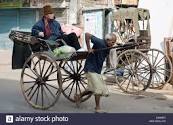
The CEC meeting was fruitful and took many important decisions. I wanted some books to be purchased and during the lunch break on the second day I got down from the Yuba Kendra building where the CEC was holding and caught a riksha to go to the book stall. I was pondering on some issues, but after a few minutes, all of a sudden I felt that the riksha was moving very very slowly. Looking to the rikshawalla, I realised to my shock that it was not a cycle riksha. A very old weak man was pulling the riksha by his hands and slowly moving forward. It was a hand pulled riksha.

I asked him to stop and got down. I asked him what is the charge to the book  stall. He said Rs.5 and I gave him the money. I engaged a taxi  and went to the book stall. 

Even now, one can see many hand pulled rikshas in the norther cities. In some cities like Calcutta, they were offered cycle / auto rikshas by the government, but many still prefer to their hand pulled rikshas.


BSNLCCWF Central Secretariat.

The central Secretariat of the BSNLCCWF met today through video conference and discussed about the serious issues of the contract workers and casual workers including retrenchment, outsourcing, no payment of wages and took decisions for agitational programmes. This will be consulted with BSNLEU and then finalised. Wait for the details.

Com. M.S.Raja no more

Com.M.S.Raja no more
Extremely sad news. Com.M.S.Raja, former Secretary General of Audit and Accounts Association and Dy. Secretary General of the Confederation of Central Government Employees and Workers have expired today at Trichur, Kerala, at about 7.30 PM after a severe heart attack. He had settled at Trichur after his retirement from service. He was only 61.
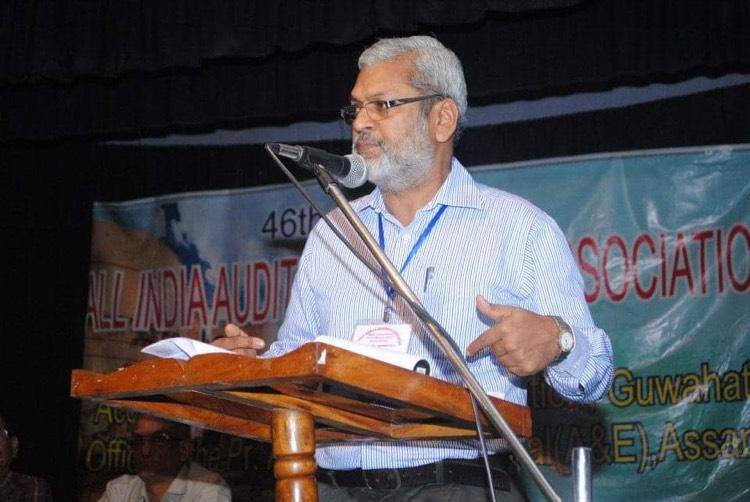
Com.Raja was was a vibrant and dedicated leader who was always on the forefront of the struggles. While at Delhi we used to meet now and then to discuss matters. Even about two weeks back, I had contacted him and requested him to work for the senior citizens through the Senior Citizens Friends Welfare Association which he agreed. On my request he also sent me a book written by Com.E.X.Joseph, a former SG of Confederation and Audit and Accounts Association. Com. Raja was a real follower of Com.S.K.Vyas.
His death is a great loss to the trade union movement of the central government employees and especially Audit and Accounts workers.
My Heartfelt condolences to the bereaved family.
Red Salute to Com. M.S.Raja!