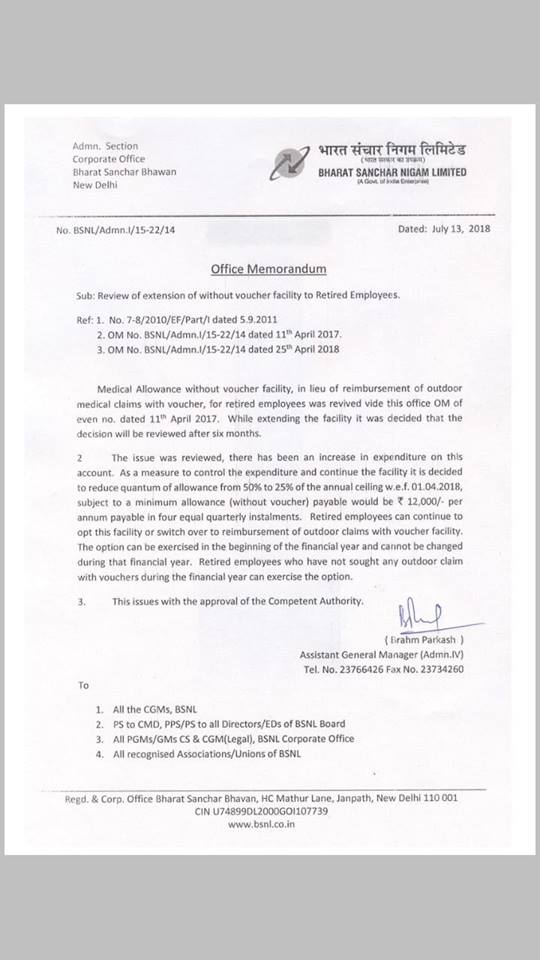
Medical Allowance restored for BSNL Retirees, but quantum reduced.

After continued efforts by AIBDPA and BSNLEU, the Medical Allowance without voucher to the BSNL retirees have been restored by BSNL. Orders have been issued. But the quantum is reduced to 50% and the minimum will be Rs. 12,000 in a year, paid in 4 installments. AIBDPA has strongly protested and demanded for restoration.

BSNL Optical Sub-marine System between Chennai and Andaman and Nicobar Islands

State-run telco, Bharat Sanchar Nigam Limited (BSNL) has given a contract to NEC Technologies India to build an optical submarine cable system between Chennai and the Andaman & Nicobar Islands. Under the deal, NEC will manufacture the optical submarine cable and provide technical assistance during the turnkey implementation.

The contract is for a system that includes a segment with repeaters from Chennai to Port Blair and seven segments without repeaters between the islands of Havelock, Little Andaman (Hutbay), Car Nicobar, Kamorta, the Great Nicobar Islands, Long Island and Rangat. The total cable length will be approximately 2,300km and carry 100Gb/s optical waves.

The cable system will provide the A&N Islands with sufficient bandwidth for supporting voice and data connectivity that enable the implementation of e-Governance initiatives, such as the establishment of enterprises and e-commerce facilities. The system will also assist educational institutes in the sharing of knowledge and will play a significant role in driving the “Digital India” vision, a campaign launched by the Government of India to ensure that Government services are made available to citizens electronically.

“BSNL is pleased to select NEC for implementing this prestigious project. We trust NEC for the technological edge they hold in the domain and their commitment to adherence of timelines to ensure successful completion of the project. This project will enable much needed high capacity connectivity with the Andaman Islands and usher a new era of development for the region,” said Anupam Shrivastava, Chairman, and Managing Director BSNL.

Courtesy: Economic Times)

Telecom TU Movement – A Saga of Struggles, Sacrifices and Achievements

Telecom Trade Union Movement – A Saga of Struggles, Sacrifices and Achievements

Introduction

The P and T (including BSNL) employees and their unions/associations are observing this year, the 50th anniversary of the historic One Day Token Strike of 19th September 1968. Four years back in 2014, the 60th year of the formation of National Federation of Posts and Telegraph Employees (NFPTE), the militant organisation of the P and T employees, was celebrated.
The central government, whether headed by UPA or NDA, has been continuing the implementation of its anti-worker, anti-people neo-liberal policies, which are completely detrimental to the interest of the nation and the people. All-important PSUs are in the list of the NITI Ayog for privatisation or closure to suit the requirement of the corporates, whose influence on the government is well known.
Both the Postal and the BSNL workers are in sustained struggles to save the Postal and BSNL services from privatisation and to provide a better service. It is a hard battle and requires the whole hearted support of the entire trade unions and the common people to defeat the nefarious policies of the government.
In this context, it will be appropriate and a requirement for the Postal and BSNL workers to know the past and the various struggles organised. In this connection, I have authored a book “History of the P and T TU Movement” , published by NFPE and released in its All India Conference last year at Bengaluru by Comrade Tapan Sen, M.P., General Secretary of CITU. The book reviews the period from the start of the TU movement till 1986, when NFPTE was bifurcated in to NFPE and NFTE, consequent to the bifurcation of the Department in to Postal and Telecom. The appreciation received by the book as also request from many comrades has made me to think about writing about the history of the movement since 1986. First I am thinking of writing about the telecom unions (including BSNL) from 1986 to the present period. This will be serially posted in this blog, for the present.
Our senior comrades, who were part of the movement, are requested to guide and help me in improving, modifying and correcting, if there is any thing missing, mistake etc.
The articles will start from tomorrow serially.
V.A.N.Namboodiri, Founder General Secretary, BSNL Employees Union.

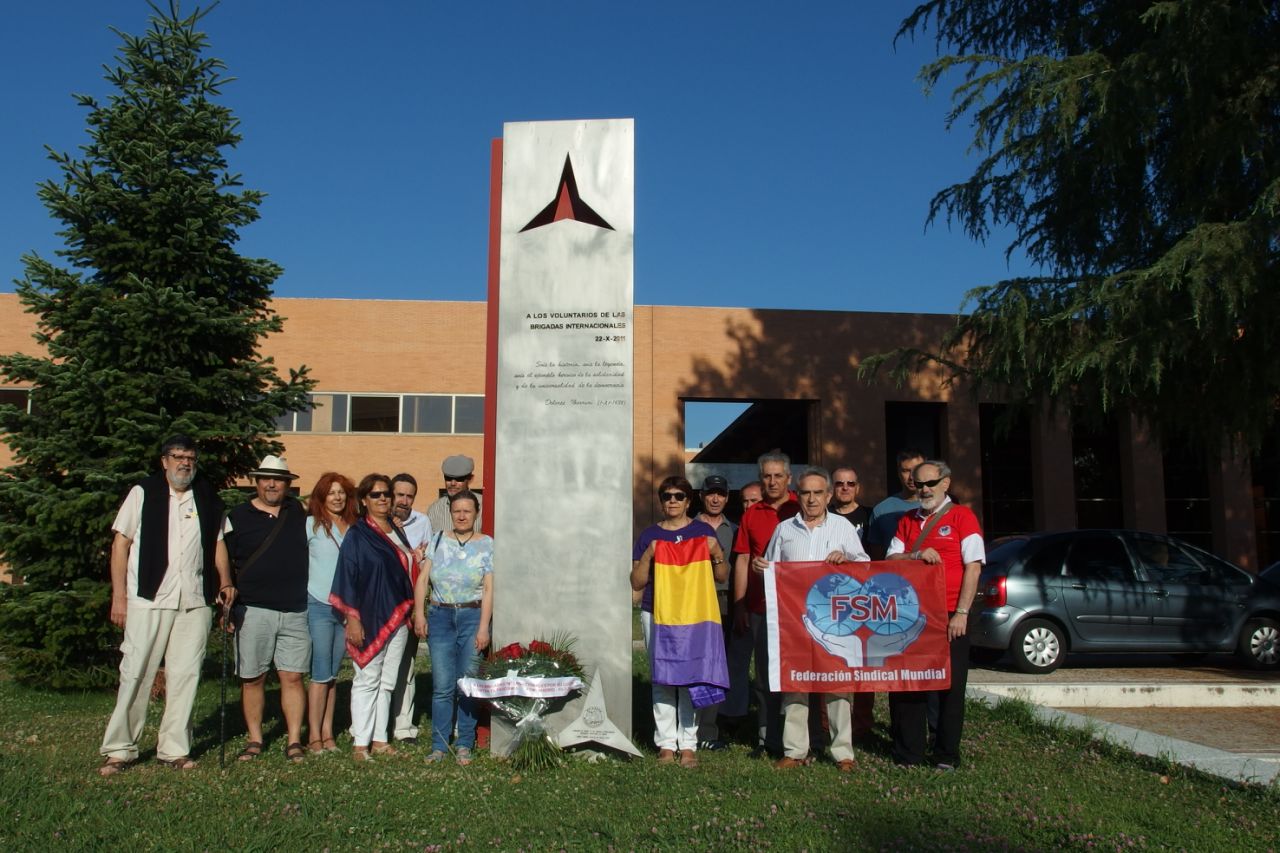
WFTU leaders at International brigades Monument, paying Homage.


Madrid, Spanish State: The WFTU laid a wreath at the International Brigades Monument on 10 of July 2018
10 Jul 2018EUROPE, SPAIN
The WFTU laid a wreath at the International Brigades Monument on 10 of July 2018

Book on Historical One Day Token Strike of 19th September 1968.

The One Day Token Strike of Central Government Employees on 19th September 1968 was historic in all aspects, the demands, the huge participation, the draconian punishments, arrests, dismissals, terminations and so on. Striking workers were killed by gun shots as also by running train over the picketers – the eternal martyrs. The fight against victimisation was a saga of determination and tenacity to ensure that each and every dismissed / terminated worker is reinstated.

19th September 2018 is the 50th anniversary of this mighty struggle of lakhs of workers. I am writing a book on the One day Historic Strike to be released on 19th September. There were 290 comrades terminated in P and T in Kerala alone. I would request our comrades in Kerala, who have got some information about the strike in their towns/cities/area like participation in the strike, victimisation, fight against victimisation etc. to kindly send to me so that those incidents can also be included. Photographs, if any, in connection with the strike, including the photoes of the leaders may kindly be send to the following address;

V.A.N.Namboodiri, S-8, Alhind Elite Apartments, P.O. Nadakkav Kozhikode – 673011. Mob: 9868231431 E-mail: van.namboodiri@gmail.com

Thanks to all.

BSNL starts Internet Telephony Service – Congratulations!

State-run telecom firm BSNL today unveiled the country’s first internet telephony service that will allow users to dial any telephone number in India through its mobile app.

Now BSNL customers will be able to make calls using the company’s mobile app “Wings” to any phone number in the country.

Before this, phone calls on mobile apps was possible within users of a particular app and not on telephone numbers.

“In present competitive environment, increase in market share by BSNL is laudable. I congratulate BSNL management for internet telephony which will enable consumers to make call without SIM,” Telecom Minister Manoj Sinha said after inaugurating the service.

Using this service, BSNL customers will be able to make calls on any network in the country even by using BSNL wi-fi or any other service provider.

Telecom Commission, highest-decision making body of the Department of Telecom, had allowed companies who hold valid telecom licence, to provide app-based calling service even by using wi-fi connection.

The service provider will be required to comply with all the interception and monitoring related requirements and calls will be charged by telecom operators and all rules related to normal calls will be applicable on them.

The registration for this service will start this week and the services will be activated from July 25 on wards. (Courtesy: Press Reports)

BSNL Workers, Pensioners organise mighty demonstrations demanding Pension- wage revision etc.

As per the decision of the All Unions Associations in BSNL (AUAB), mighty demonstrations with maximum participation of regular workers, pensioners and casual contract workers were held all over the country on 10th July, demanding immediate wage revision, pension revision, grant of 4G Spectrum to BSNL and also pension contribution to the government strictly on the basis of the wage of the employee. These were agreed to by the Minister in his meeting with the AUAB.

The unions demanded the BSNL, DOT and the Minister to ensure and implement the assurances given by the Minister.

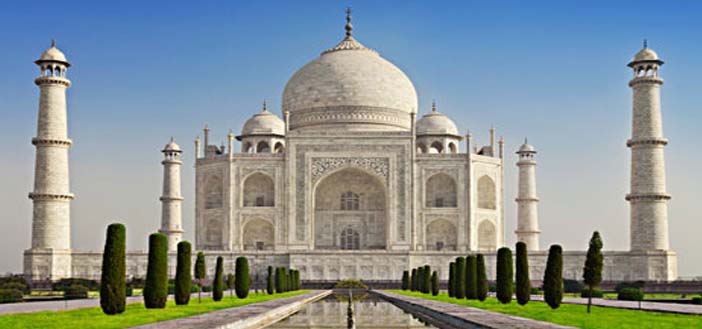
Take immediate action to protect Taj Mahal – SC to Central, UP Governments


The Supreme Court today slammed the Centre and its authorities for their “lethargy” in taking steps to protect the Taj Mahal, dubbing the issue of preserving the historic medieval structure a “hopeless cause”.
The apex court also expressed anguish over the Uttar Pradesh government failure to come out with a vision document to preserve and protect the Taj Mahal.
It directed the Centre to furnish full details of the steps taken and action required to be taken for protecting the iconic monument.
A bench of Justices M B Lokur and Deepak Gupta said no concrete steps have been taken by the government, despite a parliamentary standing committee report on Taj’s protection.
The Centre told the bench that Indian Institute of Technology, Kanpur was assessing air pollution level in and around the mausoleum and will give its report in four months.
It said a special committee has also been set up to find the source of pollution in and around the Taj, which will suggest measures to prevent it.
The bench said it will hear the matter on day-to-day basis from July 31.( Courtesy: PTI)

Homage to 1960 July Strike Martyrs!

On 11th July 2018, the CG employees observe the 58 th year of the historical 5 days strike of July 1960. We pay homage to the martyrs of the 1960 strike, who were killed at Dahod Railway station:

1. Com.Ranjit Singh

2. Com.Dakharam

3. Com.Sitaram

4. Com.Kripa Shankar

Com. Ekambaram Telephone Operator who committed suicide after terminated from Service.

(The name of other comrades who were killed are not available now.)

Red Salute to the Martyrs of 1960 Strike.

The Historical Indefinite Strike of CG Employees, July 1960. Homage to the Martyrs!

11th July 2018 is the 58th anniversary of the great struggle of the Central Government employees which started on 11/12th July 1960 and continued for 5 days.

The Indefinite Strike was the result of the continuous negligent attitude of the central government on the demands of the CG employees. The First Pay Commission was appointed after the historical 22 days P and T strike in 1946, in which the British Government was compelled to concede all the 12 major demands raised by the employees. India got Independence in 1947 and the CG employees were also exhilarated that now they will be working under Indian Government headed by Indians. The “Socialist pattern of Society” declared by Prime Minister Pandit Jawaharlal Nehru gave the hope that the issues of the CG employees will also be considered favourably. However, the NFPTE and Confederation were compelled to issue a strike notice demanding appointment of II Central Pay Commission, only after which the Pay Commission was appointed.

But the report of the II CPC was completely retrograde. Neither the Need Based Minimum Wage prescribed by the 15th Indian Labour Conference held in 1957 was accepted/recommended nor any clear formula for grant of DA when cost of living index increased was prescribed. The government was not even prepared to discuss with the Confederation of CG employees, NFPTE and other federations on improving the recommendations, stating that it is an ‘award’. The employees had no other alternative but to go n an indefinite strike.

The government reacted with anger. How the CG employees can go on strike in independent India, when the government is trying to improve the lot of the people? How can they oppose the government elected by the huge majority of the people and led by a great leader like Jawaharlal Nehru, the freedom struggle leader? The government regarded the strike as a ‘Civil Rebellion’ and promulgated the draconian ‘Essential Service Maintenance Ordinance’ by which the strike in central services were banned. Those who went on strike were liable to be arrested and jailed for six months and a fine of Rs. 500 imposed. Those who supported the strike or gave any assistance to them were to be punished with one year jail and Rs.1000 fine.

It is to the credit of the leadership and workers that they braved the threats and went on strike well knowing the consequences. The indefinite strike started in the midnight of 11/12 the July 1960. Employees on duty from the telephone exchanges, telegraph, post and RMS offices walked out at the tick of the clock and the great strike started. The Railway employees stopped their duty and the trains were stopped and piled up in the stations and nothing could move. Defence factories stopped working. The central administration Delhi, including the offices of the ministers stopped functioning with the employees on strike in the Central Secretariat. About 3000 CG employees were in jail since 17th September for participation of a massive rally in support of the strike. All leaders were arrested and jailed. NFPTE Secretary General, Com. P.S.R.Anjaneyulu was arrested, handcuffed and made to walk through the streets. It was taken away only when the magistrate ordered the police to remove it.

The Youth Congress along with the Special branch, local police etc. was on the look out for the strikers, who went underground in many places to avoid arrest. Tens of thousands of strikers were arrested and put in jail all over India. Railway workers were killed by police firing and purposely over run by trains. Two comrades committed suicide, including Com. Ekambaram, Telephone Operator, Palakkad, who could not adjust to the punishment of termination and a family to support. The government actions were nothing short of a vicious attack on the enemy in a war.

The workers understood the cruel face of the government. They continued the strike for 5 days, though all the leaders were in jail. At last, the leaders called off the strike from the jail.

The ordeal was not over. Thousands of strikers who came to rejoin duty were suspended and terminated from service. Hundreds of termination notices were issued to temporary employees. Rule 14 charge sheets were issued to many to dismiss them from service. Even the British government did not treat any strike like this. Asking and fighting for the legitimate rights of the workers was treated as a crime.

Com.A.K.Gopalan and other M.P.s raised the issue of vacation of victimisation in the Parliament and severely criticised the Government. They asked, ‘is it the same Jawaharlal Nehru, who supported the railway Strike of the British workers in 1926 and also the P and T Strike of 1946 in India, who is treating the present strike as ‘Civil rebellion’ and punishing the workers?’ Vacate the cruel punishments, they demanded.

All these had some effect. By about four years, all who were terminated and dismissed were taken back, suspensions revoked and court cases withdrawn. It was a great relief to the workers.

The strike and the victimisation in 1960 convinced me and many other young workers that there is no other alternative to the workers other than a strong union and sustained struggle to advance the cause of the workers.

But the anger and fire in their mind and heart did not vanish even for a second. It was burning throughout the years and the result was the mighty One Day Toke Strike of 19th September 1968, the 50th anniversary of which is being observed this year.

The 1960 strike, though brutally suppressed, was not in vain. In fact, no struggle is in vain. The result may not come immediately, but it is bound to come. In this struggle also it was the same. The government was compelled to appoint two DA commissions one after another for recommending formula for DA revision and formation of a forum for discussion, the Joint Consultative machinery (JCM).

While observing the 50th anniversary of the epic strike, let us pay homage to the martyrs of the 1960 strike and also pledge ourselves to continue the great tradition and fight for the right of the workers and for justice to the down trodden. It has become most important at this stage, especially when the hard won rights of the workers are being taken away one after another and even ‘hire and fire’ formula is being implemented the Modi government itself through ‘fixed term’ jobs.

STRUGGLE FOR UNITY, UNITY FOR STRUGGLE, AND STRUGGLE AND UNITY FOR PROGRESS!