• ‘My Story’ by Com. Jyoti Basu
  • About
  • Settlement of Medical Bills of Pensioners
  • Historic Victory!
  • Disclosure Policy

VAN Namboodiri's Blog

~ Welcome to V.A.N. Namboodiri's blog…

VAN Namboodiri's Blog

Author Archives: VAN NAMBOODIRI

Full judgment of the SC in Casual regularisation case

13 Monday Aug 2018

Posted by VAN NAMBOODIRI in BSNLCCWF - Casual and Contract workers

≈ Leave a comment

Tags

casual labour - regularisation, judgment

We have mentioned about the significant judgment of the Supreme Court in our earlier post. The full judgment is given below:

Narendra Kumar Tiwari vs The State Of Jharkhand on 1 August, 2018
Author: M B Lokur
REPORTABLE IN THE SUPREME COURT OF INDIA

CIVIL APPELLATE JURISDICTION

CIVIL APPEAL NOS.7423-7429 OF 2018
(Arising out of S.L.P. (Civil) Nos. 19832-19838 OF 2017)
Narendra Kumar Tiwari & Ors. Etc. ….Appellants

versus

The State of Jharkhand & Ors. Etc. ….Respondents

JUDGMENT
Madan B. Lokur, J.
1. Leave granted.
2. These appeals arise out of the common judgment and order dated 17th November, 2016 passed by a Division Bench of the High Court of Jharkhand in a batch of writ petitions relating to the regularisation of daily wage or contract workers on different posts. The writ petitioners (now appellants) were denied the benefit of regularisation in view of the provisions of the Jharkhand Sarkar ke Adhinasth Aniyamit Rup se Niyukt Ewam Karyarat Karmiyo ki Sewa Niyamitikaran Niyamawali, 2015 (hereinafter referred to as the Regularisation Rules). Signature Not Verified Digitally signed by SANJAY KUMAR Date: 2018.08.01
3. The admitted position is that the appellants are irregularly 15:47:00 IST Reason:
appointed employees of the State Government. They sought regularisation of their status on the ground that they had put in more than 10 years of service and were therefore entitled to be regularised. The High Court took the view that the decision of the Constitution Bench of this Court in Secretary, State of Karnataka and Ors. v. Umadevi (3) and Ors.1 did not permit their regularisation since they had not worked for 10 years on the cut-off date of 10th April, 2006 when the Constitution Bench rendered its decision. According to the High Court, the Regularisation Rules provided a one-time measure of regularisation of the services of irregularly appointed employees based on the cut-off date of 10 th April, 2006 in terms of the judgment of the Constitution Bench. Therefore, since the appellants had not put in 10 years of service they could not be regularised.
4. The appellants had contended before the High Court that the State of Jharkhand was created only on 15 th November, 2000 and therefore no one could have completed 10 years of service with the State of Jharkhand on the cut-off date of 10th April, 2006. Therefore, no one could get the benefit of the Regularisation Rules which made the entire legislative exercise totally meaningless. The appellants had pointed out in the High Court that the State had issued Resolutions on 18th July, 2009 and 19th July, 2009 permitting the regularisation of some employees of the State, who had obviously not put in 10 years of service with the State. 1(2006) 4 SCC 1 Consequently, it was submitted that the appellants were discriminated against for no fault of theirs and in an irrational manner.
5. Having heard learned counsel for the parties and having considered the decision of the Constitution Bench in Umadevi (3) as well as the subsequent decision of this Court explaining Umadevi (3) in State of Karnataka and Ors. v. M.L. Kesari and Ors.2, we are of the view that the High Court has erred in taking an impractical view of the directions in Umadevi (3) as well as its consideration in Kesari.
6. The decision in Umadevi (3) was intended to put a full stop to the somewhat pernicious practice of irregularly or illegally appointing daily wage workers and continuing with them indefinitely. In fact, in paragraph 49 of the Report, it was pointed out that the rule of law requires appointments to be made in a constitutional manner and the State cannot be permitted to perpetuate an irregularity in the matter of public employment which would adversely affect those who could be employed in terms of the constitutional scheme. It is for this reason that the concept of a one-time measure and a cut-off date was introduced in the hope and expectation that the State would cease and desist from making irregular or illegal appointments and instead make appointments on a regular basis.
7. The concept of a one-time measure was further explained in Kesari in paragraphs 9, 10 and 11 of the Report which read as follows: 2 (2010) 9 SCC 247 “9. The term “one-time measure” has to be understood in its proper perspective. This would normally mean that after the decision in Umadevi (3), each department or each instrumentality should undertake a one-time exercise and prepare a list of all casual, daily-wage or ad hoc employees who have been working for more than ten years without the intervention of courts and tribunals and subject them to a process verification as to whether they are working against vacant posts and possess the requisite qualification for the post and if so, regularise their services.
10. At the end of six months from the date of decision in Umadevi (3), cases of several daily-wage/ad hoc/casual employees were still pending before courts. Consequently, several departments and instrumentalities did not commence the one-time regularisation process. On the other hand, some government departments or instrumentalities undertook the one- time exercise excluding several employees from consideration either on the ground that their cases were pending in courts or due to sheer oversight. In such circumstances, the employees who were entitled to be considered in terms of para 53 of the decision in Umadevi (3), will not lose their right to be considered for regularisation, merely because the one-time exercise was completed without considering their cases, or because the six- month period mentioned in para 53 of Umadevi (3) has expired. The one-time exercise should consider all daily-wage/ad hoc/casual employees who had put in 10 years of continuous service as on 10-4-2006 without availing the protection of any interim orders of courts or tribunals. If any employer had held the one-time exercise in terms of para 53 of Umadevi (3), but did not consider the cases of some employees who were entitled to the benefit of para 53 of Umadevi (3), the employer concerned should consider their cases also, as a continuation of the one-time exercise. The one-time exercise will be concluded only when all the employees who are entitled to be considered in terms of para 53 of Umadevi (3), are so considered.
11. The object behind the said direction in para 53 of Umadevi (3) is twofold. First is to ensure that those who have put in more than ten years of continuous service without the protection of any interim orders of courts or tribunals, before the date of decision in Umadevi (3) was rendered, are considered for regularisation in view of their long service. Second is to ensure that the departments/instrumentalities do not perpetuate the practice of employing persons on daily-wage/ad hoc/casual basis for long periods and then periodically regularise them on the ground that they have served for more than ten years, thereby defeating the constitutional or statutory provisions relating to recruitment and appointment. The true effect of the direction is that all persons who have worked for more than ten years as on 10-4-2006 [the date of decision in Umadevi (3)] without the protection of any interim order of any court or tribunal, in vacant posts, possessing the requisite qualification, are entitled to be considered for regularisation. The fact that the employer has not undertaken such exercise of regularisation within six months of the decision in Umadevi (3) or that such exercise was undertaken only in regard to a limited few, will not disentitle such employees, the right to be considered for regularisation in terms of the above directions in Umadevi (3) as a one-time measure.”
8. The purpose and intent of the decision in Umadevi (3) was therefore two-fold, namely, to prevent irregular or illegal appointments in the future and secondly, to confer a benefit on those who had been irregularly appointed in the past. The fact that the State of Jharkhand continued with the irregular appointments for almost a decade after the decision in Umadevi (3) is a clear indication that it believes that it was all right to continue with irregular appointments, and whenever required, terminate the services of the irregularly appointed employees on the ground that they were irregularly appointed. This is nothing but a form of exploitation of the employees by not giving them the benefits of regularisation and by placing the sword of Damocles over their head. This is precisely what Umadevi (3) and Kesari sought to avoid.
9. If a strict and literal interpretation, forgetting the spirit of the decision of the Constitution Bench in Umadevi (3), is to be taken into consideration then no irregularly appointed employee of the State ofJharkhand could ever be regularised since that State came into existence only on 15th November, 2000 and the cut-off date was fixed as 10 th April, 2006. In other words, in this manner the pernicious practice of indefinitely continuing irregularly appointed employees would be perpetuated contrary to the intent of the Constitution Bench.
10. The High Court as well as the State of Jharkhand ought to have considered the entire issue in a contextual perspective and not only from the point of view of the interest of the State, financial or otherwise – the interest of the employees is also required to be kept in mind. What has eventually been achieved by the State of Jharkhand is to short circuit the process of regular appointments and instead make appointments on an irregular basis. This is hardly good governance.
11. Under the circumstances, we are of the view that the Regularisation Rules must be given a pragmatic interpretation and the appellants, if they have completed 10 years of service on the date of promulgation of the Regularisation Rules, ought to be given the benefit of the service rendered by them. If they have completed 10 years of service they should be regularised unless there is some valid objection to their regularisation like misconduct etc.
12. The impugned judgment and order passed by the High Court is set aside in view of our conclusions. The State should take a decision within four months from today on regularisation of the status of the appellants.
13. The appeals are accordingly disposed of.
14. We may add that that it would be worthwhile for the State of Jharkhand to henceforth consider making regular appointments only and dropping the idea of making irregular appointments so as to short circuit the process of regular appointments.
………………………J. (Madan B. Lokur)

New Delhi; .……………………..J.
August 01, 2018 (Deepak Gupta)

Share this:

  • Share on Facebook (Opens in new window) Facebook
  • Share on X (Opens in new window) X
  • Print (Opens in new window) Print
  • Email a link to a friend (Opens in new window) Email
Like Loading...

Significance of Supreme Court judgement on Casual Labour Regularisation

12 Sunday Aug 2018

Posted by VAN NAMBOODIRI in Uncategorized

≈ 4 Comments

Whenever any case is filed by Casual labourers engaged after 2006 in CAT, the Govt is giving counter by quoting the 2006 judgment of Supreme Court in Umadevi’s case. CAT or High Court also reject their claim stating that after 2006 no regularization can be considered as per 2006 Supreme Court judgement in Umadevi’s case. Even in JCM (NC) Standing Committee Govt has repeated this stand. Now Supreme Court has clearly stated that 2006 judgement doesn’t mean that Govt is bound to regularise ONLY those irregularly appointed casual labourers up to 2006 only provided they complete 10 years service up to 2006 and can go on engaging casual labourers after 2006 as the question of regularization is not applicable to them and thus continue exploitation of them without regularization.

Court ruled that those appointed after 2006 should also be considered for regularization. Even if the appointment is made after 2006, those casual labourers can now approach the CAT for regularization quoting this judgement. This is the importance of this judgement.

Of course, this particular judgement will be implemented for Jhakhand State Govt casual laboureres only. But the above mentioned important observations and ruling of Supreme Court clarifying the 2006 Constitution Bench judgement of the same Court are beneficial to all casual labourers.

Similarly, the stand taken by the Govt that all appointments (engagements) of casual labourers made after 01-09-1993 are irregular and hence not eligible for regularization, will not also stand in the Court of Law after this judgement. In Umadevi’s case also Supreme Court has clearly ruled that those irregularly appointed casual labourers (even if appointed after 01-09-1993)are eligible for regularization, if they have completed 10 years of service. (Courtesy: Confederation website)

Share this:

  • Share on Facebook (Opens in new window) Facebook
  • Share on X (Opens in new window) X
  • Print (Opens in new window) Print
  • Email a link to a friend (Opens in new window) Email
Like Loading...

V.S.Naipaul passed away.

12 Sunday Aug 2018

Posted by VAN NAMBOODIRI in Obituary, Tributes

≈ Leave a comment

Tags

V.S.Naipaul

London, Aug 12 : Trinidad-born Indian-origin author V S Naipaul, known for his critical commentary on colonialism, religion and politics, has died at the age of 85, his family said early today.
“He was a giant in all that he achieved and he died surrounded by those he loved having lived a life which was full of wonderful creativity and endeavour,” his wife Lady Nadira Naipaul said in a statement.
Naipaul, who lived most of his life in England, died in his London home yesterday.
Vidiadhar Surajprasad Naipaul was born on August 17, 1932 in Trinidad into an Indian Hindu family.
He grew up in relative poverty before moving to England aged 18 after receiving a scholarship to University College, Oxford. He wrote his first novel while at Oxford University but it was not published and he battled with depression, even attempting suicide, during his struggling student days.
He left university in 1954 and found a job as a cataloguer in London’s National Portrait Gallery. He subsequently settled in England, although he travelled extensively thereafter.
Naipaul wrote more than 30 books of fiction and nonfiction during his career with a sharp critique of established religion and politicians characterising much of his work. (PTI Report)

Respectful Homage!

Share this:

  • Share on Facebook (Opens in new window) Facebook
  • Share on X (Opens in new window) X
  • Print (Opens in new window) Print
  • Email a link to a friend (Opens in new window) Email
Like Loading...

Reintroduction of Old Pension Scheme – Minister answers Lok Sabha Question

11 Saturday Aug 2018

Posted by VAN NAMBOODIRI in General, Pension

≈ Leave a comment

Tags

NPS, pension

The Central as well as state government employees’ organisations are demanding that the PFRDA should be annulled, NPS (New Pension Scheme) dropped and that the old defined benefit pension should be restored. They have called for a strike on 15th November, on demands including the above. The pension through NPS will be far less than the defined benefit pension and even is not fully assured. But the government is sticking for NPS. The reply in the Parliament shows the government’s defence of the indefensible. We fully support the demand of the central/state government employees for restoration of the old defined benefit pension scheme.

GOVERNMENT OF INDIA
MINISTRY OF FINANCE
DEPARTMENT OF FINANCIAL SERVICES

LOK SABHA
UNSTARRED QUESTION NO. 4075

TO BE ANSWERED ON AUGUST 10, 2018/SHRAVANA 19, 1940 (SAKA)
REINTRODUCTION OF OLD PENSION SCHEME

Shri Rakesh Singh

Will the Minister of FINANCE be pleased to state:

the details of drawbacks of the New Pension Scheme (NPS) introduced for the Government officials; whether the NPS is not as beneficial monetarily as the Old Pension Scheme (OPS) and if so, the details thereof; whether the Government employees are disgruntled with the NPS and if so, the details thereof; and whether the Government proposes to reintroduce the OPS replacing the NPS, if so, the details thereof and the action taken by the Government in this regard?

ANSWER

The Minister of State in the Ministry of Finance
(Shri Shiv Pratap Shulda)

(a) & (b) National Pension System (NPS) has been designed giving utmost importance to the welfare of the subscribers. Government has made a conscious move to shift from the defined benefit pension scheme to defined contribution pension scheme i.e. NPS, due to rising and unsustainable pension bill. There are a number of benefits available to the employees under NPS. Some of the benefits are enlisted below:

§ NPS is a well designed pension system managed through an unbundled architecture involving intermediaries appointed by the Pension Fund Regulatory and Development Authority (PFRDA) viz. pension funds, custodian, central record keeping and accounting agency, National Pension System Trust, trustee bank, points of presence and Annuity service providers. It is prudently regulated by PFRDA which is a statutory regulatory body established to promote old age income security and to protect the interest of subscribers of NPS.

§ The pension wealth which accumulates over a period of time till retirement grows with a compounding effect. The all-in-costs of the institutional architecture of NPS are among the lowest in the world.

§ Contribution made to the NPS Tier-I account is eligible for tax deduction under the Income Tax Act, 1961. An additional tax rebate of Rs.50000 is also allowed for contributions made to NPS Tier-I under Section 80CCD (1B) of the Income Tax Act, 1961.

§ Subscribers can withdraw up to 25% of their own contributions before attaining age of superannuation, subject to certain conditions. Further, PFRDA vide “PFRDA (Exits and Withdrawals under the NPS) (First Amendment) Regulations, 2017” dated 10.08.2017 has liberalized norms for partial withdrawals which also include reduction of requirement of minimum years of being enrolled under NPS from 10 years to 3 years from the date of joining.

§ PFRDA has increased the maximum age limit from 60 years to 65 years for joining NPS-All Citizen Model and Corporate Sector Model, vide “PFRDA (Exits and Withdrawals under the NPS) (Second Amendment) Regulations, 2017” dated 06.10.2017.

§ PFRDA vide “PFRDA (Exits and Withdrawals under the NPS) (Third Amendment) Regulations, 2018” dated 02.2018 has facilitated easy exit & withdrawal in case of disability and incapacitation of the subscriber covered under NPS.

§ Transparency and Portability is ensured through online access of the pension account by the NPS subscribers, across all geographical locations and portability of employments.

(c) & (d) Representations have been received which inter alia also include the demand that the Government may revert to old defined benefit pension system. However, due to rising and unsustainable pension bill and competing claims on the fiscal, there is no proposal to replace the NPS with old pension scheme in respect of Central Government employees recruited on or after 01.01.2004.

Share this:

  • Share on Facebook (Opens in new window) Facebook
  • Share on X (Opens in new window) X
  • Print (Opens in new window) Print
  • Email a link to a friend (Opens in new window) Email
Like Loading...

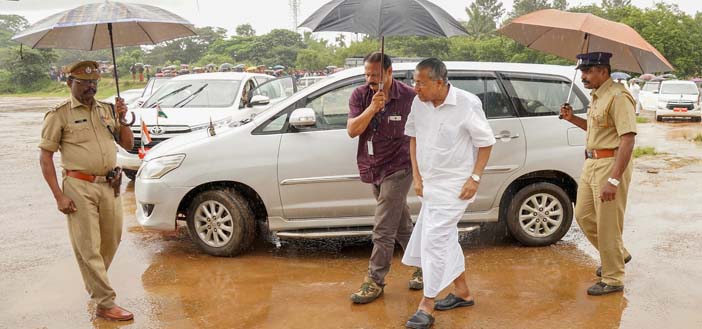
Chief Minister, Kerala, Pinarayi Vijayan visits flood affected areas.

11 Saturday Aug 2018

Posted by VAN NAMBOODIRI in Uncategorized

≈ Leave a comment

Chief minister, Kerala, Pinarayi Vijayan visiting flood affected areas.

Share this:

  • Share on Facebook (Opens in new window) Facebook
  • Share on X (Opens in new window) X
  • Print (Opens in new window) Print
  • Email a link to a friend (Opens in new window) Email
Like Loading...

No civilised country can tolerate mob violence – says K.K. Venugopal, Attorney General of India.

11 Saturday Aug 2018

Posted by VAN NAMBOODIRI in General

≈ Leave a comment

Tags

AG, Lynching - SC

K.K. Venugopal, the Attorney General of India, who is representing the Government of India in the Supreme Court, surprised every one yesterday, by openly expressing his disgust, at the failure of Maharashtra, Rajasthan and Delhi Governments, to take stern measures against mob violence. It is very important to note that Maharashtra and Rajasthan are ruled by the BJP governments, while the law and order in Delhi is being maintained by the Central Government. The Attorney General further said that no civilised country can tolerate mob violence. This remark was made by the Attorney General, before a Supreme Court Bench, consisting of Dipak Misra, Chief Justice of India, and Justices A.M. Khanwilkar and D.Y. Chandrachud. The Bench is hearing a public interest litigation against mob violence. The Judges, on their part remarked that, in the name of religion, no group can be permitted to indulge in violence.
(Courtesy: BSNLEU website)

Share this:

  • Share on Facebook (Opens in new window) Facebook
  • Share on X (Opens in new window) X
  • Print (Opens in new window) Print
  • Email a link to a friend (Opens in new window) Email
Like Loading...

Rain Fury in Kerala

11 Saturday Aug 2018

Posted by VAN NAMBOODIRI in General, Kerala

≈ Leave a comment

Tags

Floods, Kerala

The heavy rains during the last few days has resulted in landslides, floods, destruction of hundreds of homes and death in Kerala. This is unprecedented. The rain fury continues. Many towns are flooded. The government has been compelled to raise the shutters of the many dams in the state further flooding many parts of the state. The government, the political parties and the people are jointly making all efforts to save the lives, giving relief to the affected people, shifting them etc. Food is supplied. Thousands are in the relief camps. The rain may continue for two days more according to the experts. The state has never seen such fury of the floods.

Share this:

  • Share on Facebook (Opens in new window) Facebook
  • Share on X (Opens in new window) X
  • Print (Opens in new window) Print
  • Email a link to a friend (Opens in new window) Email
Like Loading...

Telecom Trade Union Movement – A Saga of Struggles, Sacrifices and Achievements (6) – CHQ Starts functioning in right earnest

10 Friday Aug 2018

Posted by VAN NAMBOODIRI in Telecom TU Movement 1991-2015, Uncategorized

≈ Leave a comment

Tags

Telecom TU Movement

(Continued from earlier post)

Functioning of CHQ
The new leadership of All India Telecom Employees Union Class III (E.III Union) started work in right earnest with V.A.N.Namboodiri, President and Moni Bose, General Secretary staying at Dada Ghosh Bhawan, head quarters of the union. The “Telecom” (monthly) and ” Correspondence” (Weekly) were issued in time with not only the issues of the telecom workers, but with articles on the issues of the working class in general to educate the workers. The editorial in the first issue after Bhopal Conference was about the October Revolution in Russia, which inspired an entire generation of workers all over the world. Coms. Atma Ram and Raghubir Singh, employees of the union continued, but it was felt that they could be more helpful.

In the morning, Moni and Namboodiri will work at HQ and in the after-noon, they will go to Sanchar Bhawan, HQ of DOT to discuss the problems of the workers. All the pending issues were being taken up in a systematic way. The condition of the old car handed over by O.P.Gupta, former General Secretary, was pitiful as almost every day, it will have some break down on the way. Hence the car was in the garage only. We used to go to Sanchar Bhawan, either in bus or auto. The Metro Service has not started and it was very difficult to get auto and going by bus with more than double the passengers was almost an impossible task. However, there was no other way.

During these journeys to DOT and discussions, Moni was firm that Namboodiri should also accompany him. After the work at Sanchar Bhawan, both will go to the residence of Com. Neelotpal Basu, M.P., son-in-law of Moni Bose, in V.P.House and take tea/tiffin or sometimes dinner itself. His daughter, Susmitha Bose was employed in Delhi. It will always be 09.00 to 10.00 PM by the time we reaches back to DGB, somehow managing to get an auto or bus.

Within days, Com. Jyotsna Bose, wife of Moni Bose, also came to Delhi from Calcutta. She was a Telephone operator and was a leader of the union and had retired by that time. She used to prepare very tasty food for both of us.

I stayed in a room, which had no ventilation at all, but there was no other alternative. Though I have stayed at CHQ two- three times for one or two months earlier as Assistant General Secretary of the union, it was only after the Bhopal AIC that I started staying at CHQ continuously. When I was AGS, O.P.Gupta, GS never asked me to come to CHQ. I used to come on my own. But when I came, he entrusted me a lot of work and worked in-cordination. Those visits and stay at CHQ helped at present in attending to the day to day work. (To be continued)

Share this:

  • Share on Facebook (Opens in new window) Facebook
  • Share on X (Opens in new window) X
  • Print (Opens in new window) Print
  • Email a link to a friend (Opens in new window) Email
Like Loading...

Important Supreme Court Judgment on Regularisation of Casual labour

10 Friday Aug 2018

Posted by VAN NAMBOODIRI in BSNLCCWF - Casual and Contract workers

≈ 6 Comments

Tags

BSNLCCWF, Regularisation, sc judgment

The Supreme Court of India in Civil Appeal nos. 7423- 7429 of 2018 in Narendra Kumar Tiwari vs. The State of Jharkhand has delivered a very important judgment on 1st August 2018 with regard to the regularisation of the casual labours.  This was an appeal by a casual labour of the State Government of Jharkhand against the decision of the judgment of the High Court of Jharkhand denying regularisation on the basis of the Karnataka and others vs Umadevi judgment.

The Supreme Court in its order has stated as follows: “Under the circumstances,we are of the view that the Regularisation Rules must be given a pragmatic interpretation and the appellants, if they have completed 10 years of service on the date of promulgation of the Regularisation Rules, ought to be given the benefit of service rendered by them. If they have completed 10 years of service, they should be regularised unless there is some valid objections to regularisation like misconduct etc.” The full text of the judgment is being published in the bsnlccwf website, bsnlccwf.in

This gives a fair interpretation of the earlier SC judgment denying regularisation. BSNLCCWF has already taken note of the judgment and will decide future course of action in this matter.

Share this:

  • Share on Facebook (Opens in new window) Facebook
  • Share on X (Opens in new window) X
  • Print (Opens in new window) Print
  • Email a link to a friend (Opens in new window) Email
Like Loading...

73rd Anniversary of Nagasaki bombing – UN Secretary General attends

09 Thursday Aug 2018

Posted by VAN NAMBOODIRI in WORLD NEWS

≈ Leave a comment

Tags

Nagasaki Bombing

Peace Statue in Nagasaki

Tokyo, Aug 9 : Nagasaki is marking the 73rd anniversary of the atomic bombing over the city, joined by the head of the United Nations for the first time amid the effort to push forward North Korea’s denuclearization.

UN Secretary-General Antonio Guterres urged all countries to commit to nuclear disarmament and to take concrete steps as he raised concerns about the slowing effort.

He said fears of nuclear war are still present 73 years after the Nagasaki and Hiroshima bombings and that they should never be repeated.

Nagasaki Mayor Tomihisa Taue urged Japan’s government to do more to lead nuclear disarmament around the world.

The bombing of Nagasaki on August 9, 1945, was the second US nuclear attack on Japan, killing 70,000 people, three days after the bomb dropped on Hiroshima killed 140,000. (Press Report)

Share this:

  • Share on Facebook (Opens in new window) Facebook
  • Share on X (Opens in new window) X
  • Print (Opens in new window) Print
  • Email a link to a friend (Opens in new window) Email
Like Loading...
← Older posts
Newer posts →

Welcome to my blog…

Unknown's avatarWelcome to my personal blog. Kindly let me know your comments and suggestions...

Blog Stats

  • 1,669,756 hits till today

Enter your email address to subscribe to this blog and receive notifications of new posts by email.

Join 3,099 other subscribers

Facebook link

Facebook link

Flag Counter (Latest)

free counters

Tag Cloud

78.2% 78.2% IDA AIBDPA Air india black money Bonus BSNL BSNLCCWF BSNLEU BSNL for Better Service BSNL strike Casual labour CEC CG employees CITU closure CMD CMD BSNL Contract workers corruption CPI(M) Cuba death anniversary Defence Delhi Dharna Disinvestment DOT EPF EPFO FDI Forum Gratuity Greece India India corruption Kerala Left Parties Merger Minimum Wage MTNL National convention NCCPA NPA opposition Palestine Parliament. Parliament March penalty pension Pensioners privatisation Protest PSU PSU Banks PSUs Railways Revival of BSNL Save BSNL SBI SC Spectrum Spectrum Auction strike Telecom Telecom TU Movement Tower company TRAI US VII CPC Vodafone W.Bengal Wage revision wages WFTU

Categories

  • 2G Scam Corruption
  • AIBDPA – BSNL DOT Pensioners
  • AUAB
  • B.N.Ghosh Book
  • BSNL
  • BSNL – Better Service to the Nation
  • BSNL News
  • BSNLCCWF – Casual and Contract workers
  • BSNLEU
  • CG Employees
  • CITU
  • coal gate scam
  • Corruption
  • CTU
  • Disinvestment
  • Forum
  • General
  • General Elections 2014
  • History
  • IDA
  • Independence Struggle
  • India Left
  • Kerala
  • Kerala floods
  • Kerala LDF Government
  • Left News
  • Membership Verification
  • NCCPA
  • Neo-liberal policy
  • News
  • Obituary, Tributes
  • P&T TU History
  • P&T TU Movement
  • Parliament
  • Pension
  • Politics India
  • Post
  • Postal Service
  • Price Rise
  • privatisation
  • PSU
  • Railway
  • Railway
  • SAVE BSNL CAMPAIGN
  • SCFWA
  • Spectrum
  • Sustained struggles
  • Telecom
  • Telecom TU Movement 1991-2015
  • Train Journeys
  • TU News
  • TU News – India
  • TU News – International
  • TU News – Telecom specific
  • TUI of P&R
  • TUI of Pensioners and Retirees
  • Uncategorized
  • VII CPC
  • VII Membership Verification
  • VISIT THE PAST
  • Wage Revision BSNL – 2017
  • WFTU
  • Women
  • WORLD NEWS

Archives

  • September 2026
  • July 2026
  • June 2026
  • May 2026
  • February 2026
  • January 2026
  • September 2025
  • August 2025
  • July 2025
  • May 2025
  • April 2025
  • March 2025
  • February 2025
  • November 2024
  • October 2024
  • September 2024
  • August 2024
  • July 2024
  • May 2024
  • April 2024
  • March 2024
  • January 2024
  • December 2023
  • November 2023
  • October 2023
  • September 2023
  • August 2023
  • July 2023
  • May 2023
  • March 2023
  • February 2023
  • January 2023
  • December 2022
  • November 2022
  • October 2022
  • September 2022
  • August 2022
  • July 2022
  • June 2022
  • May 2022
  • April 2022
  • March 2022
  • February 2022
  • January 2022
  • December 2021
  • November 2021
  • October 2021
  • September 2021
  • August 2021
  • July 2021
  • June 2021
  • May 2021
  • April 2021
  • March 2021
  • February 2021
  • January 2021
  • December 2020
  • November 2020
  • October 2020
  • September 2020
  • August 2020
  • July 2020
  • June 2020
  • May 2020
  • April 2020
  • March 2020
  • February 2020
  • January 2020
  • December 2019
  • November 2019
  • October 2019
  • September 2019
  • August 2019
  • July 2019
  • June 2019
  • May 2019
  • April 2019
  • March 2019
  • February 2019
  • January 2019
  • December 2018
  • November 2018
  • October 2018
  • September 2018
  • August 2018
  • July 2018
  • June 2018
  • May 2018
  • April 2018
  • March 2018
  • February 2018
  • January 2018
  • December 2017
  • November 2017
  • October 2017
  • September 2017
  • August 2017
  • July 2017
  • June 2017
  • May 2017
  • April 2017
  • March 2017
  • February 2017
  • January 2017
  • December 2016
  • November 2016
  • October 2016
  • September 2016
  • August 2016
  • July 2016
  • June 2016
  • May 2016
  • April 2016
  • March 2016
  • February 2016
  • January 2016
  • December 2015
  • November 2015
  • October 2015
  • September 2015
  • August 2015
  • July 2015
  • June 2015
  • May 2015
  • April 2015
  • March 2015
  • February 2015
  • January 2015
  • December 2014
  • November 2014
  • October 2014
  • September 2014
  • August 2014
  • July 2014
  • June 2014
  • May 2014
  • April 2014
  • March 2014
  • February 2014
  • January 2014
  • December 2013
  • November 2013
  • October 2013
  • September 2013
  • August 2013
  • July 2013
  • June 2013
  • May 2013
  • April 2013
  • March 2013
  • February 2013
  • January 2013
  • December 2012
  • November 2012
  • October 2012
  • September 2012
  • August 2012
  • July 2012
  • June 2012
  • May 2012
  • April 2012
  • March 2012
  • February 2012
  • January 2012
  • December 2011
  • November 2011
  • October 2011
  • September 2011
  • August 2011
  • July 2011
  • June 2011
  • May 2011
  • April 2011
  • March 2011
  • February 2011
  • January 2011
  • December 2010
  • November 2010
  • July 2010

Meta

  • Create account
  • Log in
  • Entries feed
  • Comments feed
  • WordPress.com

Meta

  • Create account
  • Log in
  • Entries feed
  • Comments feed
  • WordPress.com

Pages

  • ‘My Story’ by Com. Jyoti Basu
  • About
  • Disclosure Policy
  • Historic Victory!
  • Settlement of Medical Bills of Pensioners
  • RSS - Posts
  • RSS - Comments

Blog at WordPress.com.

  • Subscribe Subscribed
    VAN Namboodiri's Blog
    Join 468 other subscribers

    Have a WordPress.com account? Log in now.

  • VAN Namboodiri's Blog
    View site in Reader
    Manage subscriptionsSign upLog in
    Report this content
    Collapse this bar
Loading Comments...
%d