2020, A YEAR CRISES HAS PASSED. 2021 WITH FRESH HOPES HAS ARRIVED.
MY BEST WISHES FOR A HAPPY NEW YEAR TO ALL FRIENDS, COMRADES AND WELL WISHERS!

01 Friday Jan 2021
Posted in Uncategorized
2020, A YEAR CRISES HAS PASSED. 2021 WITH FRESH HOPES HAS ARRIVED.
MY BEST WISHES FOR A HAPPY NEW YEAR TO ALL FRIENDS, COMRADES AND WELL WISHERS!
01 Friday Jan 2021
Posted in Uncategorized
MY LIFE AND STRUGGLES -32
COM. K.G.BOSE PASSED AWAY
Great tragedy struck P and T movement. Com.K.G.Bose, revolutionary leader and President of NFPTE, passed away on 11thDecember 1974 at Royal Hospital London, where he was admitted for treatment of dreaded cancer. Entire P and T fraternity was in shock and dismay at loss of the great leader.
Along with Dada Ghosh, Com.KG ensured that entire P & T workers in Bengal and Assam participated in 1946 Postmen Strike. He was jailed and dismissed in connection with 1947 proposed strike. Led 1960 historic strike. He was Circle Secretary of E.III and P.III Unions of W.Bengal as also President of P.III Union. Later he was elected as President of NFPTE. He was elected as MLA to W.Bengal Assembly and also functioned as Member of Pay Commission for W.Bengal State employees. His simplicity and comradely approach to workers were appreciated by all.
K.G.’s health deteriorated due to continued tour and hectic activities. It was diagonised that he was suffering from cancer and was admitted in London Hospital for expert treatment, but could not be saved.
As mentioned earlier, Kerala comrades had a special attachment to him. He had attended Joint Circle Conference of P & T Unions held at Calicut in 1965. He also visited Calicut later. I had earlier mentioned about my first meeting with him in the Trivandrum All India Conference, where he took up the disciplinary case with Member P and T board and settled.
I got opportunity to discuss with him many issues and seek his advice. He was prompt in replying to letters and explained various issues in details. I still keep some of his letters with me. His younger brother, Com.Moni was also a veteran leader of P & T employees and was terminated from service in connection with 1949 strike. He was elected as General Secretary of E.III Union, defeating O.P.Gupta in Bhopal AIC, where I was elected as President. Moni Bose became first Patron of BSNLEU. He passed away in 2010.Com.K.G.’s speeches in All India Conferences were heard with rapt attention. In between sessions, young comrades like us used to meet him and get advice on how to present issues in AIC.
His death is a great loss to CG and P&T employees and a personal loss to me. He will always be remembered as one of the great leaders of P and T trade union movement. He continues to be inspiration for many generations of workers. The road in front of his house is named “K.G.Bose Sarani” in his honour.
Red Salute to Com.K.G.Bose!(to be continued)
Photos. 1. Com.K.G.Bose 2. Myself with Com. Moni Bose 3. KG with wife Com. Parul Bose 4. Procession with Com.K.G. Bose after reciving him at Calicut Railway Station. Myself on his right side.
01 Friday Jan 2021
Posted in Uncategorized
MY LIFE AND STRUGGLES – 31
GLORIOUS RAILWAY STRIKE – 1974
Bonus Convention held at New Delhi focused demand of Bonus to CG Employees. The slogan ‘Bonus for All’ caught imagination of workers. This was effectively taken up by Railway workers under leadership of Com. George Fernandez, Secretary General of AIRF.AIRF organised a Convention of all unions in Railways on 27th February 1974 to discuss the matter. More than 3000 delegates representing about one hundred unions attended. National Co-ordination Committee of Railwaymen’s Struggle (NCCRS) was formed as also an Action Committee with Com. George Fernandez as Convener. It was decided to organize indefinite strike from 8th May 1974, mainly on the demand of Bonus. Confederation of CG Employees and NFPTE (KG Bose) also gave strike notice. NFPTE (OPG) not only did not give strike notice, but also opposed it.
The central government was rattled by strike decision. Strike was to start from 8th May but due to mass arrest of George Fernandez and other leaders, it started 6 days earlier in Railways. Central government met strike with utmost cruelty and vengeance. Tens of thousands of workers were arrested and jailed. Railway Quarters were searched and even family members were beaten and harassed. In many staff quarters, water – electricity connections were cut. It was all-out attack on workers.
In Calicut, procession organized in support of strike was lathi-charged by police. Participants severely beaten. Two newspaper reporters also badly beaten and hospitalised. It was terror unleashed against strikers and their supporters. Due to split in Confederation and NFPTE, the strike could not be continued for more than 3 days by central government employees and was withdrawn. Railway workers continued strike. Strike support committee was doing all what could be done.
It was at this time that Com. A.K.Gopalan, M.P. , great working class leader, along with his wife Com. Suseela Gopalan arrived at Calicut. He was not well and doctors advised complete rest. He was taking rest at the residence of Advocate P.K.Kunhirama Poduval. When I reported to him about the serious situation in Railway Colony, he wanted to go to there immediately. Though we tried to stop him, he was adamant. Wherever there is suffering, he will rush there, despite ill health.
We started for Railway Colony. He stepped out from car at entry gate of the colony and started walking. Com.A.Kunhiraman Nair, veteran NGO Union leader and some other comrades also reached by the time. We were about 6-7 people and led by Coms AKG and Suseela, started walking slowly in to the colony through the small road. Women and children who were alone in colony houses saw AKG, started joining us. Within few minutes, it became a big jatha and culminated in the school premises inside colony. By this time, police reached. Party comrades also reached. A loudspeaker was brought and Com.AKG started speaking. One police official, without knowing who it was speaking, came forward and threatened to arrest. AKG told him that ‘I am AKG and you can arrest me’. The poor policeman was dumbfounded, became silent. By that time, senior police officers came and normalised the situation. AKG spoke consoling the families of Railwaymen and told that nothing will happen to them. He warned police officers that he will come and sit in dharna if harassment continues. The meeting was over after Com. Suseela Gopalan also addressed. After this incident, there was a halt to harassment of families in colony.
The Railway strike continued for about three weeks. All leaders and thousands of workers were arrested. Heavy victimisation took place. It was only after change in government at Centre that victimisation could be got vacated. Strike was full success in P and T in Kerala and W.Bengal. 40 workers were terminated and many workers including me suspended. Continued agitations were organised against victimisation. It was only after Janatha government was formed in 1977, that reinstatement and vacation of victimisation could take place. (to be continued).Photos 1. George Fernandez 2. Suseela Gopalan 3. Memorial to Com. A.K.Gopalan 4. Com.A.K.Gopalan.
01 Friday Jan 2021
Posted in Uncategorized
MY LIFE AND STRUGGLES – 30
ORGANISATION – CRUCIAL ISSUES
Last years of 1960s and 1970s were very crucial period for NFPTE. Differences in dealing with workers’ problems as well as ideological line divided NFPTE in to almost two equal parts.
Federal Council held at Vijayawada on 9-14 May 1970 was witness to sharp debate on the line to be taken against anti-worker stand of government. There was severe criticism against Gnaniah – OPG leadership for not organising serious struggles against victimisation of 1968 strike. NFPTE leadership was indefinitely waiting for leniency to come from government, doing nothing, accused progressive leadership led by Coms. K.G.Bose, N.J.Iyer, K.Adinarayana and L.A.Prasad.K.G.Bose and A.S.Rajan were elected as President and Secretary General of NFPTE, in a bitter contest, defeating OPG team. It was a bolt from blue to dominant leadership; a victory for progressive section. Defeated OPG – Gnaniah group created difficulties for new leadership to function, misusing their proximity to administration and government. They were unable to accept the unexpected defeat.
Next Federal Council was held at Calcutta from 28 October to 3 November 1971. KG Bose and AS Rajan were once again elected as President and SG. Well knowing that they cannot win in election, OPG group walked out, prepared a parallel list and submitted to government. Instead of accepting duly and constitutionally elected list, government refused recognition to both. Misusing political connection, OPG group managed to get recognition later.
When majority is lost, it has always been the tactics of revisionists to divide organisation and keep at least one portion of it with them. Unity and democracy is not very important to them. This can be seen again in post-1991 Bhopal AIC election, in which OPG and team was defeated
P and T, Bonus and ED Conventions at DelhiP and T, Bonus and ED Conventions from 10 to 12 December 1972 held at Delhi organised by NFPTE led by KG Bose group were great success. More than 2,500 workers attended from all parts of India. 500 workers participated from Kerala alone. Along with other comrades, I also participated.
Many Kerala comrades reached Delhi, even without a sweater or woollen shawl. It was December and severe biting cold. Suffered a lot. Staying arrangement for Kerala team was made in a well-covered, underground hall of a factory in Narayana, which gave some relief.
Bonus Convention was jointly organised by Confederation of CG Employees and All India State Government Employees Federation. Demand of ‘Bonus for All’ was raised and approved by the Convention. Decided to observe ‘Bonus for All Day’ on 19th January 1973. In addition to employees’ leaders, Prof. Madhu Dantwade M.P., Dr. Mathew Kurien M.P., P.Ramamurty (CITU), Gyan Chand (UTUC), George Fernandez (HMP) and others addressed.
There was an interesting scene during ED Convention. When Com. P.Chellappan Pillai, Kerala Circle Secretary of Postmen and Class IV Union, started speaking in Malayalam, delegates wanted translation. Com. L.A.Prasad, General Secretary, Administrative Union immediately took mike and translated. A GS hailing from T.Nadu, translating Malayalam speech of Circle secretary, Kerala in to Hindi!
After P and T Convention, a huge procession started from Convention site to Raisina Round about, passing through main roads of the capital. Com.N.J.Iyer wearing a red cap, leading the procession, was a sight to see. A real Commander of the working class. Police tried to stop at several points, but the jatha marched ahead till it reached Raisina round about, near Parliament. (Now processions are stopped in front of Parliament Police Station. But during that period, processions were allowed up to Boat Club, just opposite and near to Parliament). Communications Minister Shri H.N.Bahuguna came and accepted the Memorandum presented. Later he met union delegation at his house and discussed the issues.
These conventions created enthusiasm and inspiration amongst the participants and workers at large. It was also a show of strength. Proved that majority of workers are with KG Bose group. ED issues were focussed. Demand of Bonus to CG Employees high lighted, which was main demand of 1974 Railway Strike (to be continued).Photos: 1. Parliament 2. K.G.Bose 3. P.Ramamurthy 4.George Fernandez 5. N.J.Iyer 6. K.Adinarayana
01 Friday Jan 2021
Posted in Uncategorized


01 Friday Jan 2021
Posted in Uncategorized
MY LIFE AND STRUGGLES – 28
SUSTAINED STRUGGLES AGAINST VICTIMISATION (CONTD)
Charge sheets were issued under Rule 14 of CCS (CCA) Rules against suspended officials, proposing major penalties including dismissal. Participation in strike, dharna, demonstration, intimidation of non-strikers etc. were the charges. Charge sheets were issued even to some of those officials who were not suspended.
Union adopted many tactics to delay enquiries, since early disposal meant serious punishments including dismissal. After some time, situation may become normal and punishments will be less.
Charged employee has got the right to nominate another official as Defence Assistant to assist him in enquiry. Usually union leaders, who knew rules and were expert in such matters, were nominated. They pointed out several omissions and remissions in the conduct of the enquiry, framing of charges etc. and delayed proceedings. Another tactic was to cross examine witnesses in such a manner so that they become frustrated and contradict themselves. Inquiry Officers and Presenting Officers were no match to these experts.
Coms.K.P.Govindan Kutty, M.C.Ayyappakutty and some other senior leaders were nominated as DA. I attended as Defence Assistant in about 30 cases. Almost on all days, there were sittings of enquiries. The dates had to be fixed according to our availability.
Charges in many of these enquiries could not be proved. But Disciplinary Authorities, mostly DE and SDEs, invariably imposed punishments, whether found guilty or not. Fortunately, there were no dismissals except that of Com.N.P.Padmanabhan, Convener of P and T Co-ordination Committee of Kerala. He was reinstated only after the Janata Government came to power in 1977. Gradually, situation improved and severity of punishments got reduced. However, union leaders were imposed with serious penalties.
Most of the suspended workers were reinstated after some months, except a section of senior leaders. They continued to be under suspension. I was one among them.
Court Cases
There was no court cases filed against striking employees, since state government has already declared that no action will be taken under ESMO in the state. To overcome this situation, officers of various departments were directed by central government to file criminal cases against those participated and/or instigated. 13 such criminal cases were filed in Calicut involving all leaders and some other officials. These cases continued for years. Well known advocates S/Shri P.K.Kunhirama Poduval, Bhaskaran Nambiar, Balakrishnan Nair and K.Jayaraj attended these cases, without charging any fee. Shri Raman Nair, Vakil Clerk of Adv. Poduval was of great help.
Advocate Poduval was unable to attend on the day of final hearing of a serious case as he was laid up. Charges included gherao of an officer and forcible cancellation of a charge sheet. Poduval directed us to Senior Advocate Shri Kunhirama Menon, his partner in the firm, requesting him to attend final hearing. We met him. He agreed to attend. Exactly at 10.00 hours he reached Magistrate Court, which he might not have visited for many decades. He usually attended High Court only. He was respected even by senior judges. Magistrate and advocates were surprised at his presence. Immediately our case was taken. He argued for half an hour in such a way that even we thought that such an incident never occurred. APP had nothing to say. Case was dismissed then there. All cases were over by about two years. Except the first case, all others were dismissed. On appeal, punishment was cancelled in that case also.
We arranged a reception for the advocates at Hotel Alakapuri, but nothing more than tea they will have. We thanked them for their invaluable assistance.
At the initiative of Advocate Shri T.C.N.Menon, M.P., who was also Chairman of Kerala P and T Co-ordinating Committee, cases were filed against termination of all 300 temporary officials. As per direction of Com.Menon, local co-ordinating committee conveners reached Ernakulam, where High Court is situated, prepared petitions and all were filed on the same day. It was almost miraculous. After about two years, these cases came up for hearing. All termination orders were cancelled since the provisions in CCS (CCA) Rules that either payment of one month’s advance salary is to be paid before termination or that a notice of one month should be there was not followed by authorities. This was a great victory. All terminated employees were reinstated and arrears of salary paid.
During the entire period, many agitational programmes were organised as per call of NFPTE as also Co-Ordinating Committee of P and T Unions Kerala. As a result, a good number of young workers became very active in union. They became big asset for union.
I have mentioned about the strike and post-strike situation of Calicut only. It was almost same in other stations of Kerala. All these have been mentioned in the book on 19th September Strike written and published by Com.P.V.Chandrasekharan and me.Within 2 – 3 years, normalcy returned. Of course, scars of victimisation continued for some more time (to be continued).
28 Monday Dec 2020
Posted in Uncategorized
SUSTAINED STRUGGLES AGAINST VICTIMISATION OF 1968 STRIKE
One Day Strike of 19 July 1968 ended by 12.00 hours mid-night. When we went to attend duty next day, orders of suspension were waiting. Within few days, most of active workers were suspended or terminated according to whether one was a permanent or temporary employee. Provision of Rule (5) of Temporary Service Rules was misused for termination. This was the situation in Kerala as well as all over India. Maximum number of terminations in Calicut Telegraph Engineering Division. Tension between DET K.S.Thomas and Union due to many local agitations, gherao etc was main reason. He tried to settle accounts misusing post-strike period. Terminations would have been much more, but for a clever move by Com. A.Achunni, who was establishment section clerk and union leader. He put up case of about 60 officials due for confirmation before DET about one week earlier and got them confirmed. This reduced number of terminations.
There were 44 terminations and 95 suspensions in Calicut city alone, including Postal, RMS, Telegraph and Telephones. Most of the comrades in Telecom Lodge were under suspension, including District Secretary Com.Karayi Sreedharan, P.V.Nambissan, V.Kesavan, K.Prabhakaran, E.P.Sukumaran and me. In addition, Coms. K.Bhaskaran Nair,K.Krishnan, N.V.Raghavan, K.C.S.Nair, A.Achunni, P.A.Thomas, M.V.Sadanandan, P.Appu, E.Richards, T.Kalliani, P.V.Unnikrishnan, K.Kunhikrishnan (BDA), P.P.Sankaran Kutty, K.Vijayan, P.A.Thomas, C.V.Warrier, R.Rajendrn, P.G.Ravindran V.Gopalan, P.Ravindranath, Sreekantan Nair and many others were also suspended.
In Postal side, Comrades K.Damodaran, K.T.Muhammed (famous drama artist and writer), U.Ramachandran Nair, K.V.Velayudhan, Janaki Kutty, V.M.Padmanabhan Nair, T.Chathukutty, A.P.Noorudin were under suspension.
In Telegraphs, Comrades K.Chandran, P.Moidu, K.Velaudhan and others were suspended. In RMS, Comrades Soman Gangadharan, K.P.Unnikrishnan Nambissan, N.Devanand and some others were under suspension.
(I might have missed names of many comrades who were suspended as union records have been either lost or misplaced. Comrades who remember any other name may kindly inform so that their names can be included.)
Condition of terminated employees was pathetic. Most of them were young recruits who had entered service recently and not got confirmed. Never thought that they will lose their jobs for participation in strike. Believed in their union and leaders. It was responsibility of union to protect them. It is exactly what union did.
Many parents criticised them for going on strike, causing loss of job. It was difficult for them to sit at home. About 20-25 of these comrades used to come to Telecom Lodge in morning to avoid continued criticism at home. We will supply them tea. We were all suspended and it was very difficult to provide food daily for all these comrades.
By about 7.30 hours, along with these young comrades we will go to some of the factories, which usually start work at 08.00 hours. Will meet union leaders there. Meeting will be held in front of factory and one of us standing on a wooden stool will explain about strike, termination and other cruel victimisation by central government and request support. Will give them donation coupon of 10 paise and collect fund.
After workers entered factory, will go to nearest low cost tea shop and provide breakfast. Usual menu, tea and cooked tapioca.
After 10.00 hours, go to offices of state government, central government etc. with 10 paise coupons. Meet union leaders and workers and collect donation. Kerala N.G.O.Union, KGPTA, KSEBWA, KSRTCEA and other unions and their leaders gave full support and contributed. Sometimes, we will go to merchants, shops and collect donation.
Almost every day, there will be protest jatha organised in city. Suspended and terminated workers alone were sufficient. In addition, working employees also. Starting point was usually telephone exchange. Jatha with around 200 – 300 will go through Palayam, S.M.Street and end either at RMS Office, Post Office or Telegraph Office, where meeting will be held and two or three comrades address. Sometimes it will be ‘Torch jatha’, holding burning pieces of rubber tyre or bamboo sticks filled with kerosene oil. Slogans demanding reinstatement, revocation of suspension, against central government and Prime Minister Indira Gandhi would be raised. These jathas and meetings strengthened workers to face any eventuality.
How to support terminated employees, who will not get any salary? Suspended employees will get at least 50% subsistence allowance. On pay day every month, union leaders will meet workers who are in job and collect liberal donations. Since recognition of unions were withdrawn, it was not easy to collect membership and donations. Many leaders including me were prohibited from entering offices. Notices were pasted on entrance gates to this effect. Still we used to go and collect. Result will be one more charge sheet. Still we were able to collect donations and give full salary amount to terminated employees for first few months. Later we were compelled to collect from suspended comrades also. Local co-ordinating Committee of P and T Unions ensured that terminated comrades in all sections – Postal, RMS, Telegraph and Telephones received their relief money without fail. Once a drama with was organised at Sree Narayana memorial Hall and profit from sale of tickets utilised for paying terminated employees. ( TO BE CONTINUED)
28 Monday Dec 2020
Posted in Uncategorized
MY LIFE AND STRUGGLES – 28
SUSTAINED STRUGGLES AGAINST VICTIMISATION (CONTD)
Charge sheets were issued under Rule 14 of CCS (CCA) Rules against suspended officials, proposing major penalties including dismissal. Participation in strike, dharna, demonstration, intimidation of non-strikers etc. were the charges. Charge sheets were issued even to some of those officials who were not suspended.
Union adopted many tactics to delay enquiries, since early disposal meant serious punishments including dismissal. After some time, situation may become normal and punishments will be less.
Charged employee has got the right to nominate another official as Defence Assistant to assist him in enquiry. Usually union leaders, who knew rules and were expert in such matters, were nominated. They pointed out several omissions and remissions in the conduct of the enquiry, framing of charges etc. and delayed proceedings. Another tactic was to cross examine witnesses in such a manner so that they become frustrated and contradict themselves. Inquiry Officers and Presenting Officers were no match to these experts. Coms.K.P.Govindan Kutty, M.C.Ayyappakutty and some other senior leaders were nominated as DA. I attended as Defence Assistant in about 30 cases. Almost on all days, there were sittings of enquiries. The dates had to be fixed according to our availability.
Charges in many of these enquiries could not be proved. But Disciplinary Authorities, mostly DE and SDEs, invariably imposed punishments, whether found guilty or not. Fortunately, there were no dismissals except that of Com.N.P.Padmanabhan, Convener of P and T Co-ordination Committee of Kerala. He was reinstated only after the Janata Government came to power in 1977. Gradually, situation improved and severity of punishments got reduced. However, union leaders were imposed with serious penalties.
Most of the suspended workers were reinstated after some months, except a section of senior leaders. They continued to be under suspension. I was one among them.
Court Cases
There was no court cases filed against striking employees, since state government has already declared that no action will be taken under ESMO in the state. To overcome this situation, officers of various departments were directed by central government to file criminal cases against those participated and/or instigated. 13 such criminal cases were filed in Calicut involving all leaders and some other officials. These cases continued for years. Well known advocates S/Shri P.K.Kunhirama Poduval, Bhaskaran Nambiar, Balakrishnan Nair and K.Jayaraj attended these cases, without charging any fee. Shri Raman Nair, Vakil Clerk of Adv. Poduval was of great help.
Advocate Poduval was unable to attend on the day of final hearing of a serious case as he was laid up. Charges included gherao of an officer and forcible cancellation of a charge sheet. Poduval directed us to Senior Advocate Shri Kunhirama Menon, his partner in the firm, requesting him to attend final hearing. We met him. He agreed to attend. Exactly at 10.00 hours he reached Magistrate Court, which he might not have visited for many decades. He usually attended High Court only. He was respected even by senior judges. Magistrate and advocates were surprised at his presence. Immediately our case was taken. He argued for half an hour in such a way that even we thought that such an incident never occurred. APP had nothing to say. Case was dismissed then there. All cases were over by about two years. Except the first case, all others were dismissed. On appeal, punishment was cancelled in that case also.
We arranged a reception for the advocates at Hotel Alakapuri, but nothing more than tea they will have. We thanked them for their invaluable assistance.
At the initiative of Advocate Shri T.C.N.Menon, M.P., who was also Chairman of Kerala P and T Co-ordinating Committee, cases were filed against termination of all 300 temporary officials. As per direction of Com.Menon, local co-ordinating committee conveners reached Ernakulam, where High Court is situated, prepared petitions and all were filed on the same day. It was almost miraculous. After about two years, these cases came up for hearing. All termination orders were cancelled since the provisions in CCS (CCA) Rules that either payment of one month’s advance salary is to be paid before termination or that a notice of one month should be there was not followed by authorities. This was a great victory. All terminated employees were reinstated and arrears of salary paid.
During the entire period, many agitational programmes were organised as per call of NFPTE as also Co-Ordinating Committee of P and T Unions Kerala. As a result, a good number of young workers became very active in union. They became big asset for union.I have mentioned about the strike and post-strike situation of Calicut only. It was almost same in other stations of Kerala. All these have been mentioned in the book on 19th September Strike written and published by Com.P.V.Chandrasekharan and me.Within 2 – 3 years, normalcy returned. Of course, scars of victimisation continued for some more time (to be continued)
25 Friday Dec 2020
Posted in Uncategorized
MY LIFE AND STRUGGLES – 26
HISTORIC STRIKE OF 19THSEPTEMBER 1968
Staff Side raised in the first meeting of the National Council of newly formed Joint Consultative Machinery (JCM) itself, two most important demands of Central Government employees, viz. Need based minimum wage and grant of DA according to cost of living index. After discussion, both were rejected. As provided in bye law of JCM, Staff Side demanded arbitration, but surprisingly, it was also rejected. What progressive section in NFPTE warned earlier has become true. True colour of government stood exposed. There was no other go before unions, except to resort to agitational programmes.
It was in this situation that four major organisations of central government employees viz. Confederation, All India Railwaymens Federation (AIRF), All India Defence Employees Federation(AIDEF) and NFPTE met and formed Central Joint Council of Action (JCA) and gave call for One Day Token Strike on 19th September 1968. Leaders toured all states in preparation for strike and addressed hugely attended meetings.In Kerala Circle also, good preparations were made for strike. Office-bearers toured all stations. Leaders went to the houses of lady workers and convinced parents about importance of the strike. Action Committees as well as Strike Aid Committees were formed. Enlisted support of other trade unions and opposition political parties.
Though One Day Strike, Indira Gandhi government at the Centre took all steps to suppress it, including getting the draconic Essential Service Maintenance Ordinance (ESMO) promulgated by President. CRPF was put in all offices of central government. Com.E.M.S.Namboodiripad led Left Front Government in Kerala declared that it will not implement ESMA against workers. There were rumours that Centre will dismiss Kerala Government as in 1959, but nothing happened. Central Government put CRPF inside Central offices and Kerala government put state police outside office compound for security.
Outside Calicut telephone exchange, where I was working, hundreds of workers, supporters and ordinary people were crowded from evening of 18thitself. It was very difficult even to enter exchange. Union leaders were meeting each and every worker and intimating latest developments. Officers on the other hand, had called families of lady workers and brought some of them beforehand to stay in exchange to ensure that work is performed on strike day. Water, food etc. were also stored in sufficient quantities. Almost all top officers were present inside. They were forcing officials on duty not to leave exchange after duty. Something has got to be done. Except Trunk exchange, this problem was not there, as most of workers were on strike.By about 24.00 hours (midnight), four-five of us rushed to trunk exchange and brought most of those whose duty was over and those who have come to stay there, despite stiff opposition from officers. Shouting slogans in support of strike, workers marched out of the compound. CRPF tried to stop, but in vain. They were greeted with slogans from workers outside.
One day Token Strike started exactly at midnight of 18/19 September 1968 all over India. In Calicut also it was same. The strike started in RMS Office and Telegraph Office at midnight. In Post Offices, DET, SDO Offices as also SP Office, strike started according to morning duties of Postmen and other officials.
It was only a few months back that a unit of Telephone Revenue Account Office (TRAO) was started at Calicut. Almost all staff coming to about 40 or so was new lady recruits who were transferred from Trivandrum on bifurcation of office. Only less than half a dozen were men. Strike was 100% in TRAO.
Congress, ruling party at Centre was determined to crush the strike. Congress workers at local level also made efforts, but could not do anything as in 1960, since state government was not with them. However, one senior leader of Congress with a lady telephone operator through the crowd came to gate of exchange with intention to enter. They were determined to enter and there was no other way other than to picket. I lied down on the ground and blocked them. Police, who were there, removed me. Immediately, Com.Karayi Sreedharan picketed. When he was removed, I again picketed. Police threw both of us in police lorry and took to Police station. After some time we were released and reached exchange gate again.
In Kerala as well as in the country, strike of central government employees was a great success with massive participation. Leaders were arrested and jailed in large numbers. Terror was let loose in some centres by police and CRPF. Kerala was an exception, the Left government refusing to implement ESMA. More than 12,000 employees were arrested all over India. It is estimated that about 1.5 lakh P and T workers participated.
Martyrs of 1968 Strike
Eight railway employees sacrificed their valuable lives in 1968 strike. Com. Pareesh Sanyal was shot dead at Guwahati, Assam. Coms. Raman Achari and Kishan Gopal were shot dead at Bikaner, Rajasthan. Coms. Lakshman Singh, Raj Bahadur, Devi Raj, Gurdeep Singh and Gama were crushed by train when they picketed. One comrade of the central secretariat was killed when the police pushed him from the upper floor. Altogether 17 comrades became martyrs of the strike. (Names of other martyrs are not available in the records).
The recognition of all the unions which gave call for strike was immediately withdrawn. Dismissals, Termination, suspension and other victimisation were imposed on tens of thousands of leaders and workers. A terror situation existed in offices and workplaces. (to be continued).
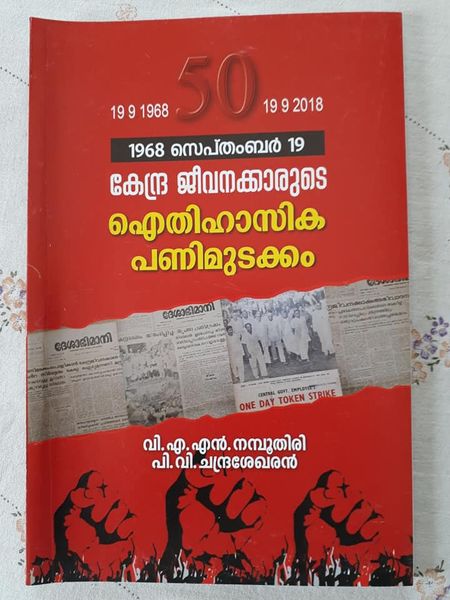
(For details of strike and connected matters please refer to (1) History of P and T Trade Union Movement, written by V.A.N.Namboodiri. The book is available for purchase (Rs.100/) with Central Head Quarters, AIPE Union Group ‘C’, Dada Ghosh Bhawan, 2151/1, New Patel Road, New Delhi – 110008, who has published the book. (2) 19th September 1968 – Kendra jeevanakkarute ithihasika panimutakkam (Malayalam) by V.A.N.Namboodiri and P.V.Chandrasekharan . A few copies are available with me. Rs.80/-)
Photo (1) Book ‘Kendirya Jeevanakkarute Ithihasika panimutakkam.”
23 Wednesday Dec 2020
Posted in Uncategorized
JOINT CONSULTATIVE MACHINERY (JCM)
The Historic Strike of July 1960, connected victimisation and other mattes have been mentioned earlier. Although strike was suppressed, it was not possible for government to completely ignore issues raised by unions.
One of the major demands raised in 1960 strike was grant of dearness allowance on full neutralisation in cost of living index. In 1964, Confederation gave call for organising agitational programmes on the issue, including an All India Demands Day on 12-08-1964. Prime Minister Shri Lal Bahadur Shastri, after meeting the union leaders appointed Shri S.K.Das, Retired Judge of Supreme Court, as One Man Committee to examine the rates of DA. This was not satisfactory to unions, since question of Dearness Allowance formula was not included in terms of reference. Das Committee did not recommend full neutralisation for cost of living. Unions protested. Government appointed another 3 men D.A.Committee with Retd Chief Justice of Supreme Court, Shri P.B.Gajendra Gadkar as Chairman. Its report was worse than that of Das Committee. Strong protest arose and agitational programmes were organised by unions.
However, some orders were issued including introduction of Family Pension for the first time, removal of discrimination in the matter of pension and certain other matters between Class III and Class IV employees etc.
Government realised that one reason for continued agitations by workers is absence of a regular forum for negotiations between government and its workers. Hence it decided that a negotiating forum like that of Whitely Council in Britain can be constituted. Discussion took place with unions of CG Employees, including P and T. The proposal for Joint Consultative Machinery (JCM) was placed by government as follows:
There will be a National Council, which will have Cabinet Secretary as Chairman and representatives from official and union side. Similarly Departmental Councils and Circle Councils. But one condition was that after the negotiating council is formed, there will be a ban on strike. This was not acceptable to unions and government was compelled to drop that condition.
There was serious internal discussion in NFPTE about accepting these proposals. It was clear that though ‘ban on strike’ condition was dropped, intention of the government was to entangle unions in eternal discussions without any result. Any negotiation can be successful only if it is supported by fighting potential. The progressive leadership of Coms. K.G.Bose, K.Adinarayana and N.J.Iyer pointed out the pitfalls in the proposals. However, proposals were accepted by the dominant leadership.
Later events proved that what the progressive section stated was fully correct (to be continued).

