India at 147 of 157 countries in commitment to reducing inequality – a shame indeed.

Tags

,

India fared poorly, ranking 147 out of 157 countries, in terms of its commitment to reducing inequality, while Denmark topped the list, a report said Tuesday.

According to the Commitment to Reducing Inequality Index developed by Oxfam and Development Finance International, Nigeria, Singapore, India and Argentina are among a group of governments that are fuelling inequality.

The index ranks 157 countries on their policies on social spending, tax, and labour rights.

As per the report, countries such as South Korea, Namibia and Uruguay are taking strong steps to reduce inequality. However, countries like India and Nigeria did very badly.

Among rich countries, USA showed a lack of commitment towards closing the inequality gap.

In terms of its ranking across specific pillars this year, India was placed 151st on the index for public spending for healthcare, education and social protection, 141st for labour rights and wages, and 50th on taxation policies.

Regionally, India ranks sixth among the eight South Asian nations. On public spending and on labour rights it ranks sixth, but India is placed on the top in terms of progressiveness of tax policy.

Other countries in the top ten include Germany (2nd), Finland (3rd), Austria (4th), Norway (5th), Belgium (6th), Sweden (7th), France (8th), Iceland (9th) and Luxembourg (10th). (A report from PTI)

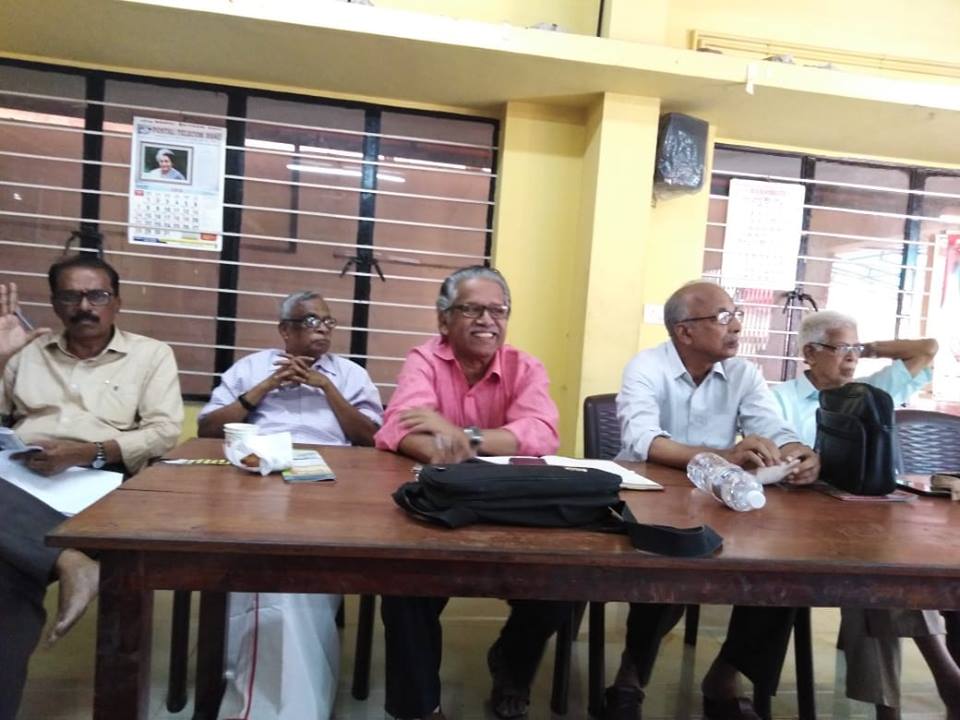
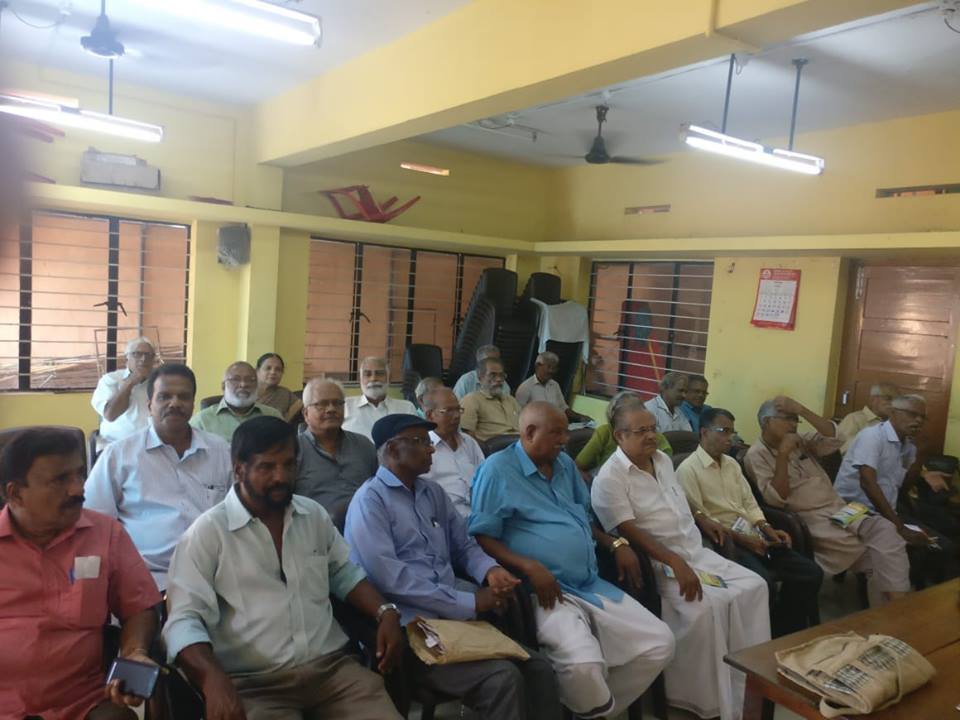
Com.V.A.N.namboodiri, Advisor inaugurated the 5th biennial district conference of Malappuram on 09-10-2018. He explained the issues of the pensioners , especially, pension revision, medical issues and the anti-people policy of the Modi government and appealed to participate in all the agitations, called by AIBDPA<AUAB,Confederation and central Trade unions. Com.P.T.M.A.jaleel, District President controlled the proceedings. Com.M.N.Madhavan welcomed the gathering. Coms.N.Guruprasad, Circle Secretary, V.P.Abdulla, District Secretary, BSNLEU, Kamalraj (SNEA) , P.T.Kunhippayi, ACS and P.Kesavadas, District Secretary, CCLU addressed the conference.

The subject session held in the afternoon was inaugurated by Com.N.Guruprasad, Circle Secretary. The biennial report and audited accounts presented by the District Secretary and Treasurer were adopted after discussion.

In the unanimous election of office bearers Com.P.T.M.A.Jaleel, M.N.Madhavan and P.Ramachandran were reelected as President, Secretary and Treasurer, respectively.(Courtesy: AIBDPA Website)

BSNL Workers resumes agitational programme on Wage / Pension Revision etc.

Tags

The AUAB resumes agitational programme – calls upon the employees to get ready for strike.

A meeting of the AUAB was held yesterday. General Secretaries / representatives of BSNLEU, NFTE, SNEA, AIBSNLEA, AIGETOA, BSNL MS, ATM and BSNL OA participated in the meeting. The meeting reviewed the progress in the implementation of the assurances given by the Hon’ble Minister of State for Communications.

The meeting expressed it’s severe disappointment that even after the lapse of 8 months, the DoT has not prepared the Cabinet Note, to get relaxation to BSNL, from the affordability clause of the 3rd PRC. Further, the meeting also observed that, the DoT has not taken any action for the implementation of the other assurances given by the Hon’ble Minister of State for Communications, such as Pension Revision, Allotment of 4G spectrum to BSNL and Payment of Pension Contribution on the actual basic pay. The meeting came to the unanimous conclusion to resume the agitational programme, including that of strike. Therefore, the meeting called upon the employees to successfully organise the following programme of action, with the view to mobilise the employees for a strike action.

Holding of press conferences at circle and district levels on 29-10-2018, and explaining the demands, especially the anti-BSNL and pro-private policies of the government.
Dharna at all levels on 30-10-2018.
Rallies at circle and districts levels on 14-11-2018.
Mobilise the employees for further serious struggles, including strike, if the demands are not settled early.

CHQ calls upon the circle and district unions to immediately get into touch with the other unions and associations, and organise the above mentioned programme effectively. Through the above mentioned agitational programme, employees should be prepared for the strike action. (Courtesy: BSNLEU Website)

Che Guevara remembered on his 51st Martyrdom Anniversary

Tags

Che Guevara, one of the greatest revolutionaries the world has ever seen, was murdered by the imperialists and their stooges on, 9th October 1967, in the forest of Bolivia, where he was fighting for the freedom of the country.

He was with Fidel Castro on their siege of Cuba for making the country free. He was a Minister of Cuba in the Fidel Castro Communist Government, but left every thing and went to Bolivia to continue his revolutionary activities. He was caught and killed in cold-blood.

Che Guevara Born on 14-06-1928.  Martyrdom 09-October 1967.

Red Salute Comrade! You will ever live in the memory of the exploited and the freedom loving people of the world!

Big Demonstration of Pensioners in Athens

Tags

,

Big Demonstration was held on October 4th by the Athens Pensioners’ Unions. The mobilization is part of the new round of action with which the pensioners’ struggle against the policy of the government that hits pensioners and pensions, against old and new pension cuts. Pensioners claim to abolish all reactive health and insurance policies as well as they demand increases in pensions.

INDIA PENSION SCANDAL – Article by Prabhat Patnaik

Tags

,

Incredible as it may seem, the union government of India provides a pension to the elderly which amounts to an absurd sum of Rs 200 each per month, and even for accessing this the beneficiary must belong to the BPL population which, as is well-known, is notoriously underestimated. True, the state governments add something to this amount, but, their resources being meagre, the additions cannot be large. What is more, this figure of Rs 200 has remained unchanged since 2006-07; even the elementary courtesy of indexing it to inflation has not been accorded to the elderly.

This is truly a scandalous state of affairs, not just because the sum is laughably paltry, the beneficiary list absurdly truncated, and even elementary protection against inflation missing, but above all because of what it reveals about the government’s attitude. This attitude sees the payment of pension as a largesse on the part of the State, an act of charity towards a set of mendicants. But an adequate old-age pension is actually a right. It is a right not just in an abstract “ought”-sense, but in the concrete sense of being an integral part of the social philosophy which underlay India’s anti-colonial struggle and upon which the Indian constitution is founded.

This philosophy which the Left has always espoused holds that the plight of an individual in society is determined by the social arrangement within which he or she lives. For instance unlike the colonialists of the pre-independence era who attributed the misery of the Indian people to their “laziness”, or lack of enterprise, or subservience to tradition, the anti-colonial struggle advanced the proposition that it was the colonial arrangement that caused the abject poverty afflicting India, whence it followed that this arrangement had to be altered by overthrowing colonial rule and erecting an alternative social arrangement that would guarantee a minimum standard of life to every Indian. The Karachi Congress Resolution in 1931, which outlined what free India would look like, held out this promise, among others. The mass participation in the freedom struggle that occurred in the 1930s was fired by this promise, which thus became a sort of “freedom charter”, upon which the new nation was founded. It acted as a precursor to the constitution.

Even though the constitution did not explicitly codify a set of fundamental economic rights, as it codified a set of fundamental political rights, the former cannot just be wished away, both because they form part of the “freedom charter” underlying the new nation, and also because the latter cannot be enjoyed without the citizen also enjoying a set of de facto economic rights. The assertion of one’s role as a citizen in a democracy cannot occur unless one enjoys a degree of economic security. Hence even though economic rights are not codified as such in the constitution, they are implicit and as fundamental as the explicitly-codified fundamental rights.

Adequate pension to the elderly is one such economic right. It is inherent in the promise underlying the constitution of free India which is visualised as a fraternity of equal citizens. Within this fraternity of equal citizens, nobody is doing anyone else a favour by accepting a legitimate demand for a minimum livelihood.

If adequate pension is an economic right, then it must be universal, like the fundamental political rights enjoyed by all. The pension scheme cannot be either contributory or means-related. It cannot be targeted, not just because any targeting invariably leaves out many deserving beneficiaries, but, more importantly, because it violates the principle of universality that must characterise all rights of citizens. To be sure, in fixing the amount of pension, the fact that a person is already drawing a pension from some other source must be taken into account; and once deduction is made on that score some will automatically get excluded or drop out, but that does not amount to an infringement on a person’s right. Likewise the pension paid by the State to every elderly person as a right must have nothing to do with any contribution from the person concerned. If someone is part of some other contributory pension scheme, he or she may opt out of the State-funded pension, or the pension amount may be suitably adjusted to prevent double benefits; but State-funded pension must be a right for every person, and it must be financed by budgetary sources, unrelated to any contribution from the beneficiary.

The provision of a laughable pittance as pension, as is the current state of affairs, is therefore a violation of the spirit of the Indian constitution, a throwback to feudal times when rulers occasionally showed kindness to the ruled by bestowing favours upon them, of the sort that our governments think they are doing in providing a pittance for a pension.

The Pension Parishad, a network of several groups, organised a dharna in Delhi on September 30 and October 1 to demand an adequate universal rights-based pension. The principle enunciated by the Pension Parishad is that the amount should be half the minimum wage, but in concrete terms the demand was for a pension of Rs 3000 per person per month. The Pension Parishad has organised a similar dharna in 2012 when the demand had been for a universal pension of Rs 2000 per month. Taking into account the price-rise in the interim, the current demand of Rs 3000 is roughly equivalent to the demand of Rs 2000 at that time.

The appropriateness of this figure can be seen from a different angle. Since poverty in India is defined in terms of a daily calorie-intake norm, namely 2100 calories per person per day in urban India and 2200 calories in rural India, the monthly per capita expenditure at which the calorie intake just met these norms could be taken as the pension amount. NSS data from quinquennial consumer expenditure surveys were used to determine these cut-off levels, and, expressed at prevailing prices, they came, in round numbers, as a weighted average between urban and rural areas, to Rs 2000 per month in 2012, which would work-out to around Rs 3000 today.

The number of potential beneficiaries was estimated by the Parishad in 2012 to be around 8 crores, which by now might have increased to about 10 crores. The annual amount required for providing old-age pensions at Rs 3000 per month to these beneficiaries would therefore come to Rs 3.6 lakh crores; allowing for a 5 percent deduction on account of voluntary drop-outs, what is required is just about 2 percent of the country’s current GDP for financing a universal rights-based pension plan.

The question often raised against such a plan is that the country cannot afford this amount. But 2 percent of GDP, it should be noted, is less than a third of the annual increment that occurs in GDP at present. The provision of this amount of pension, if it is financed through taxes paid out of incomes, would not imply any decline in the average post-tax income of the non-pensioners compared to the preceding year. On the contrary it would still mean that compared to the preceding year their per capita post-tax income would increase by about 3 percent. The payment of pensions on this scale therefore does not require any absolute sacrifice by the non-pensioners compared to the preceding year, only a smaller increase in income than would have occurred otherwise. Nobody in short needs to be squeezed in absolute terms for paying out pensions that provide a minimum living standard to the elderly.

We have assumed above that pensions would be paid out of taxes on incomes; but this is unnecessary. A Tobin Tax on currency transactions, or an increase in the existing tax-rate on stock market transactions, or a straightforward wealth tax would be a far more appropriate way of raising resources for pensions, since it would simultaneously serve other purposes such as curbing speculation or reducing wealth inequality. In fact if we assume, somewhat conservatively, that private wealth amounts to four times the GDP, and that the top 1 percent of households in India owns 62 percent of the total private wealth, then a mere 0.8 percent tax on the wealth of just the top 1 percent of households would be quite enough to finance a universal rights-based old-age pension scheme providing minimum benefits. India’s pension scandal can thus be ended quite easily; why it persists is not any shortage of resources but sheer class-antagonism, since the overwhelming bulk of potential beneficiaries are, or would have been, workers, artisans, craftsmen, peasants, and agricultural labourers.

Hunger Strike by BSNL Casual Contract workers.

As per the call of BSNLCCWF, hunger strike was organised today, 5th October 2018 in all the district headquarters of Kerala Circle. The demnds include reinstatement of retrenched workers, regularisation, regular payment of wages etc. Large number of contract workers participated. BSNL Employees and Pensioners expressed solidarity with the workers on agitation. If the issues are not settled further programmes will be organised.

Com. E.Raghava Kurup passed away

Com. E.Raghava Kurup, senior leader of NFPTE and former District Secretary of AITEU Class III, Kozhikode District passed away at his home, Vatakara, Kozhikode District in the midnight of 4-5 October 2018. He was 77. He was not well for some time and was under treatment.

Com. Kurup became a member of the union immediately after joining the P and T department and participated in all the struggles, strikes and agitations. He was in the forefront of the 1968 One Day strike of the CG employees and was awarded punishments. He was sincere, firm and close with his co-workers. He worked at Calicut and then got transferred to Vatakara from where he retired from service. He was very active in social activities and was the spirit behind the library and reading room near his home.
He leaves behind his wife and three sons. Wreaths were laid on behalf of BSNLEU, AIBDPA, NFPE and others.

A condolence meeting was held after the cremation in the nearby library. Coms. V.A.N.Namboodiri, K.V.Jayarajan, K.Damodaran and others spoke about the contributions of the deceased and expressed condolences.

Red Salute to Com. E.R.Kurup!