V A N NAMBOODIRI
17th December 2023, is being observed as the Pensioners’ Day by the pensioners organizations in memory of the Supreme Court judgment 41 years back on 17th December 1982, which is treated as the ‘Magna Carta’ of the pensioners. Since the first petitioner to the case filed was Shri D.S.Nakara, an officer of the Defence, the case is called as Nakara Case.
When the pensioners all over the word are facing many attacks on their rights and priveleges , the importance of the observing the day has increased.
Before coming to the details of the ‘Nakara case’, let us look back about the history of the pension and how connected developments took place.
The idea of pension and payment of pension started in the early 19th century. Of course, certain methods of rewarding the civilian and military officials, mainly by granting them lands and other assets were during the period of the kings, Mogals etc. That was at the will and pleasure of the king.
British Parliament passed ‘Superannuation Act‘ in 1810, modified in 1934, for grant of Pension to civil servants. Social Security Pension started after an act passed in 1946. Pension started to civil servants in USA in 1920.
Pensioners’ Act was passed in British India in 1871. The pension according to this Act was being paid at the will and pleasure of the top officers, who were mainly British. A gift for supporting the British rulers.
The 1917 Revolution in Russia and the formation of Soviet Union, the I and II World Wars, in which crores of military and civilians were killed , consequent importance of the senior citizens etc. resulted in a new approach to the pensioners and pension. Instead of a gift being given at the mercy of the rulers, pension became to be considered as a means of economic support and a social security measure for the service rendered during the heyday of their life in the interest of the country. The Family Pension started in the 1950s.
The government of independent India continued the British legacy on pension and no timely action to modify the same to the then requirement of the system was undertaken.
The First Central Pay Commission (1946) fixed the retirement age as 60 and the maximum pension was fixed at Rs. 675. The II CPC (1960) did not make any improvement. The III CPC increased the maximum amount of pension to Rs. 1000.
The historic Strikes of the CG Employees in July 1960 and 1968 compelled the Central government to look in to the problems of the employees and certain changes were made in the grant of DA etc.
But it was only in 1979 that the Central Government brought a Liberalised Pension Scheme. The maximum pension was increased to Rs. 1500. The slab system in grant of pension was discontinued and pension was granted on the basis of 50% of the average pay of the last 10 months. Certain other modifications were also there. The order was only prospective and hence a large of employees retired before 1979 did not get the benefit.
It was against this that former Financial Advisor of the Defence Ministry Shri D.S.Nakara and former Rear Admiral Shri Sathyendra Singh filed a petition in the Supreme Court for implementation of the Liberalised Pension Scheme to the earlier retirees also. An NGO by name ‘Common Cause’ also became a party to the petition. D.S.Nakara was getting a monthly pension of Rs.935 and Sathyendra Singh 981 at that time and it was liable to be increased if the scheme is implemented retrospectively as also other conditions. They pointed out that the decision of the government is in violation of the provisions of the Constitution.
The 5 Member Constitution Bench consisting of Chief Justice Y.V.Chandrachood, Justice V.D.Thulsapurkkar, Justice C.D.Desai, Justice O.Chinnappa Reddy and Justice Bahrul Islam gave their historic verdict on 17th December 1982. This judgment is called the ‘Magna Carta’ of the Pensioners because of the various comments and also the important judgment in faour of the pensioners.
What is the importance of ‘Nakara Judgment’ ?
Some of the relevant points of the judgment are given below :
Pension is neither a bounty nor a matter of grace depending upon the sweet will of the employer and that it creates a vested right subject to 1972 Rules which are statutory in character, because they are enacted in exercise of powers conferred by the provisio to Art. 309 and Clause (5) of Article 14
1. The pensioners are treated to be a class and the rules are to be implemented without considering whether they retired after or before the date of the scheme.
2. Pension is not an ex-gratia payment, but it is a payment for the past service rendered and
3. It is a social welfare measure rendering socio –economic justice to those, who in the heyday of their life ceaselessly toiled for the employer on an assurance that in their old age, they would not be left in the lurch …
4. A Pension Scheme consistent with the available resources must provide that the Pensioner would be able to live (i) free from want and with decency, independence and self-respect (ii) at a standard equivalent at the pre-retirement level…
5. The pensioners are treated to be a class and the rules are to be implemented without considering whether they retired after or before the date of the scheme.
6. The government argument that there is no such earlier example for retrospective effect of scheme has no merit.
There are many other important comments which are not mentioned here due to lack of time.
The judgment had its impact on the government and its decisions in a big way. For the first time the issue of the earlier pensioners were included in the terms of reference of the IV CPC of 1084. Like Dearness Allowance to employees, Dearness Releief was granted to Pensioners.
Slab system was changed and pension was fixed on the basis of 50% of last 10 months average pay.
Pension should be revised merging the earlier pension and DR.
The ‘Nakara Judgment’ had its impact on the Pay Commissions of the various states also as most of them were revising the pay and pension as per the guidelines of the CPCs.
What is the condition of the pensioners after 40 years of the Nakara judgment in 1982 ?
The debacle of Soviet Union and the introduction of the new economic policies based on liberalization, privatization and contractorisation, attacks after attacks are coming against the workers as well as the pensioners world over. Sustained struggles have taken place and are being organized against the attack on pension in France, Germany, England, Spain, Portugal etc.
Government of India is also in the same path. The Bhattacharya Committee appointed in 2001 recommended Contributory Pension instead of Defined Statutory Pension and the same was accepted and implemented by the Central Government for workers recruited from 2004 onwards in central services. It is to be noted that both the Congress and the BJP, the ruling and opposition parties supported and passed the passing of the anti – pensioner PFRDA Bill in the Parliament taking away the defined statutory pension for the employees and workers. All States followed suit except the then left ruled Kerala, W.Bengal and Tripura. In Kerala and Tripura also Contributory Pension Scheme was implemented after the exit of the Left governments.
The often repeated argument of the government is that the pension amount is increasing and the government will not be able to bear the expenses. It is nothing but a lame excuse.
In fact the change is also a means of providing the corporates and the big business capital by diverting the pension fund which is created through the contributory pension. Though the pension funds are mainly in the EPF etc. at present, but it is only a matter of time that the funds will be diverted to the share market and capital for corporates. The vagaries of the share market are well known and at any time the funds may vanish in the skies.
In view of the election certain states like Punjab, Rajasthan, Chattisgarh, Himachal Pradesh gave election promise that the old pension scheme will be implemented in case they win the election. But restoration to old pension scheme is being torpedoed by the central government and the EPF stating that the contribution already remitted in the EPF cannot be refunded to the states since there is no provision for the same. In Kerala, the Left Front Government has appointed a committee with regard to the restoration of the OPS and the report is being examined.
The Central govt also appointed a committee but it is only for making certain face-up for the New pension Scheme, which the workers rightly call as No Pension Scheme.
The condition of the EPF pensioners, PF pensioners and pensioners / retirees of Banks, Insurance etc are extremely difficult since their pension and other pensionary benefits are meager. In some cases revision of pension is not made. In many cases DR is not granted based on the increase of cost of living index. Even now there are PF pensioners who are getting only about Rs.500-600, though clear decision has been taken that at least a minimum of Rs. 1000 should be paid.
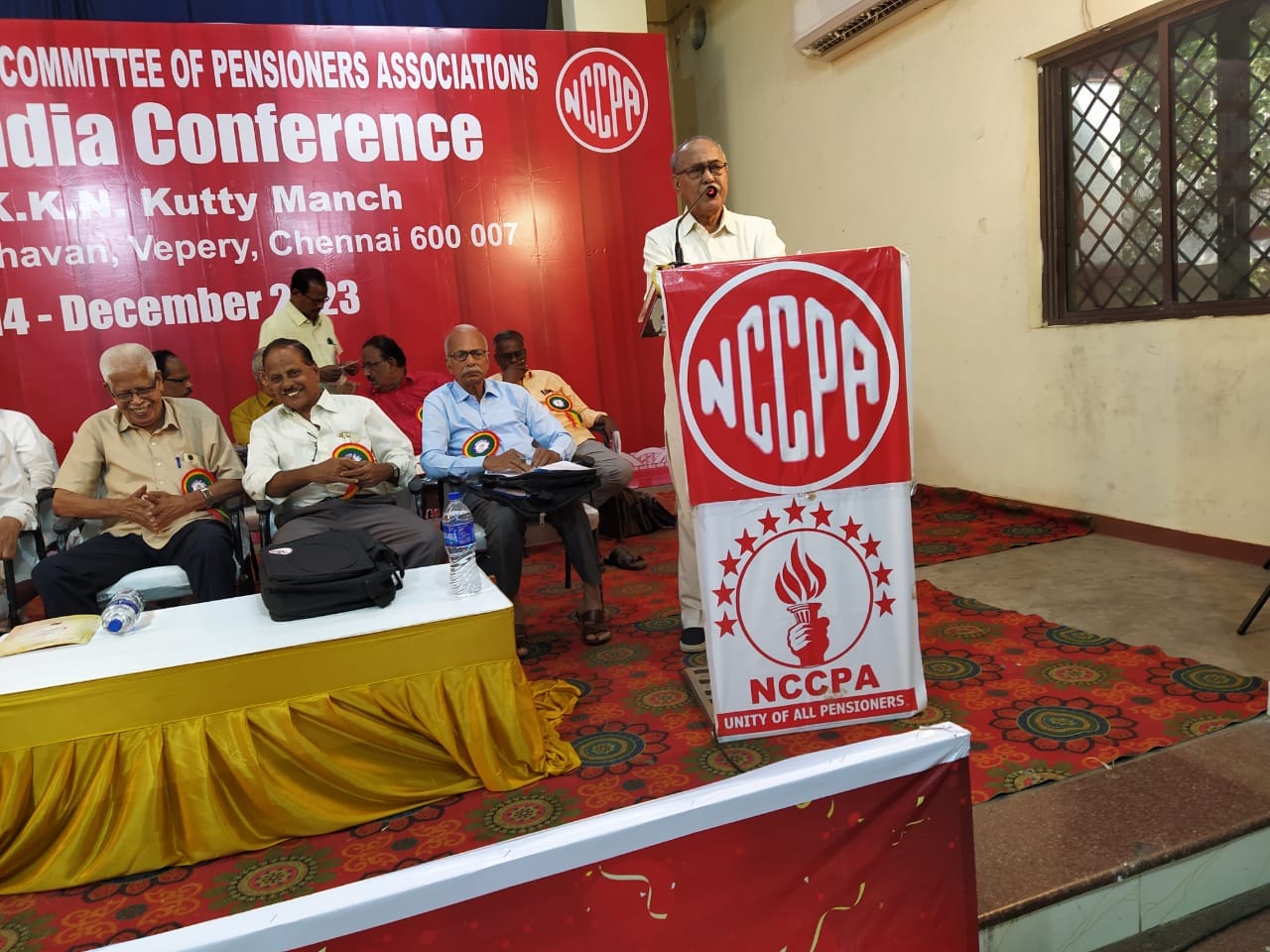
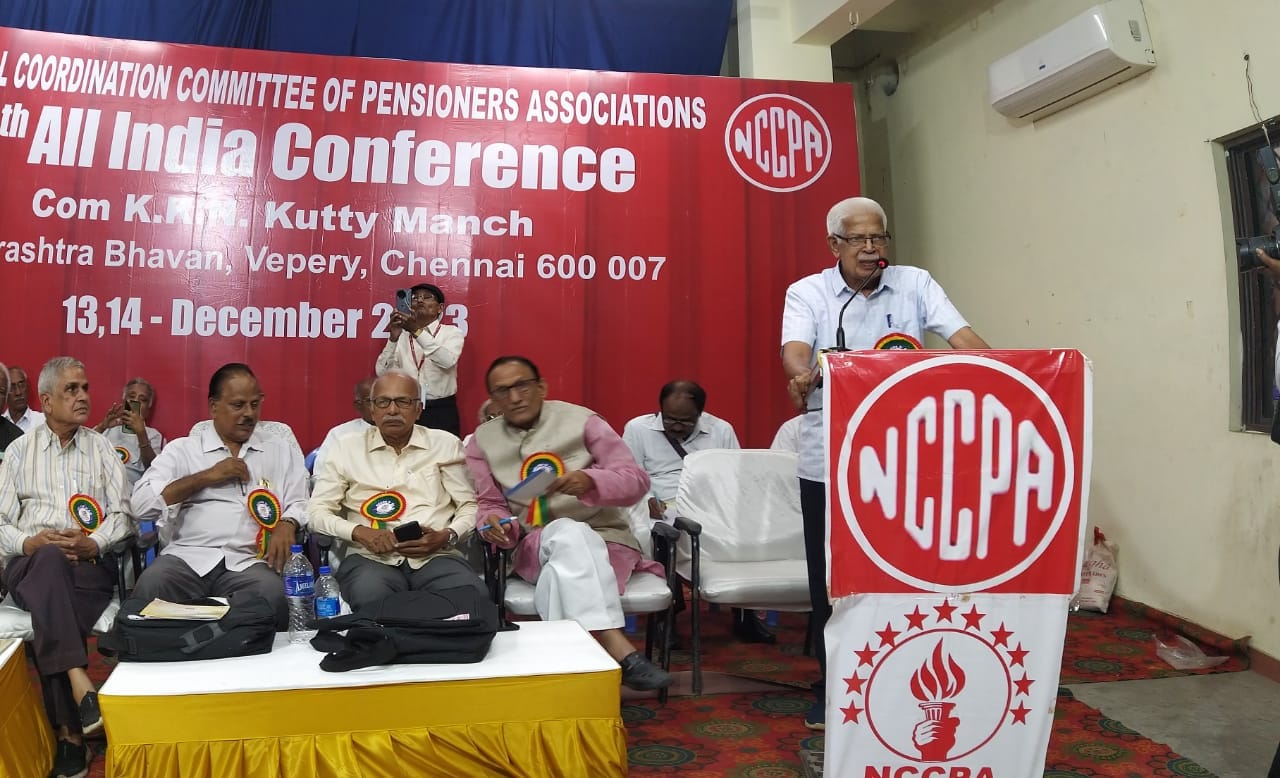
The Central government pensioners under the leadership of the NCCPA have organized many agitational programmes for the restoration of the Old Pension Scheme including a massive Parliament March and submission of Memorandum to the Prime Minister of India on issues including the restoration of OPS, Pension revision of BSNL pensioners with effect from 2017, Pension issues of the Bank retirees etc. etc. BSNL pensioners also under the leadership of AIBDPA organized a two days Dharna and sanchar Bhawan March on 24th and 25th November 2023.
The Confederation of Central government employees and workers and AISGEF jointly organized a massive rally at Ramlila Grounds Delhi on 3rd December 2023 participated by lakhs of workers on the demand of restoration of OPS.
But the government is keeping silence. It has no difficulty in writing off lakhs of ccrore of rupees of the corporate like Ambani and Adani. There is no difficulty for reducing drastically the supertax etc. This is a government of the corporates and the big business.
The General elections are going to come in the new year 2024. This is also going to be a period of struggle for the working class and the pensioners.
It is in this context that we are observing the 41st anniversary of the historic ‘Nakara judgment’, which will inspire us for further struggle to advance the cause of the crores of pensioners in the country. Let us be prepared for the same.
.




 VAN Namboodiri's Blog